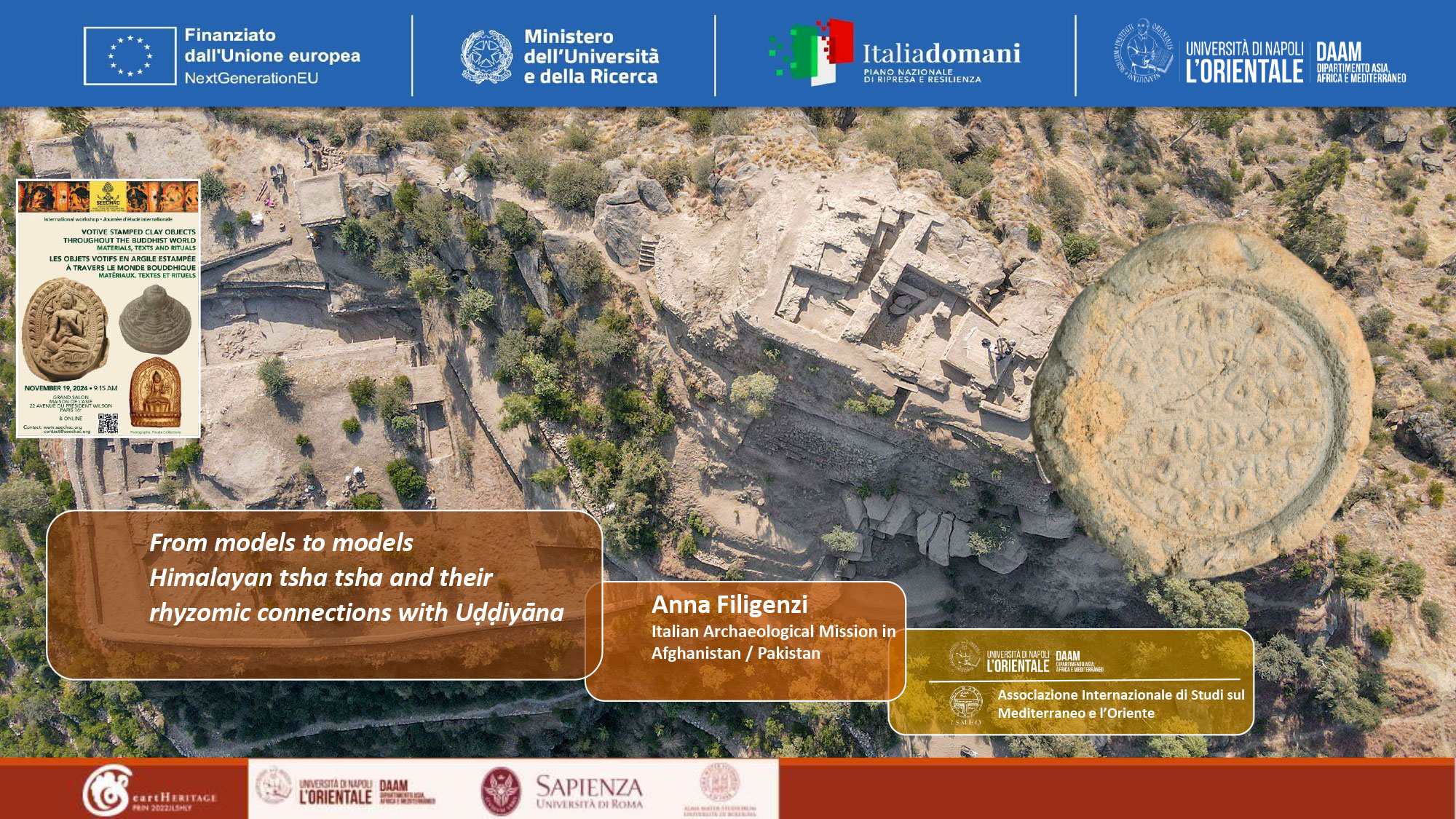
Abstract: The connections between Uḍḍiyāna and Tibet (and, by extension, the neighbouring regions) have long remained confined to the non-place of mythicised stories of a purely literary nature, which still struggle to interweave on an equal footing with other source systems. In particular, there still seems to be little room for comparison with archaeological sources, admittedly for different reasons. Archaeology, understood as the acquisition of historical knowledge based on material signs of all kinds left on a given territory by human societies and their interactions with the environment, takes a long time. Not unlike textual sources, archaeological sources can be patchy and random, and the transformation of material data into historical information is a slow process that requires, as with written sources, qualitative and quantitative validations. However, as far as the Uḍḍiyāna is concerned, archaeological research today can provide elements for comparison and integration with written sources, provided that our use of both fields of investigation takes into account the fact that the margins of overlap are by their nature imprecise and that we refrain from epistemically assuming the primacy of text over object. Although not unanimously accepted, the identification of the Uḍḍiyāna with Swat or with a wider area centred on Swat, finds firm archaeological confirmation. This allows us to consider the Buddhist art produced in Swat and neighbouring regions in the second half of the 1st millennium, and particularly between the 7th and 8th centuries, as the most direct bridge to the beginnings and developments of Himalayan Buddhist art. Indeed, studies based on archaeological data have progressively shortened the distances between the two worlds, revealing common repertoires of visual forms. Within this framework, although traces of the existence of objects equivalent to what we know as tsha tsha are tenuous in Swat and its environs, more substantial are the traces of rhizomic processes of transmission, reception and transformation of patterns which also involve the tradition of small votive plaques.