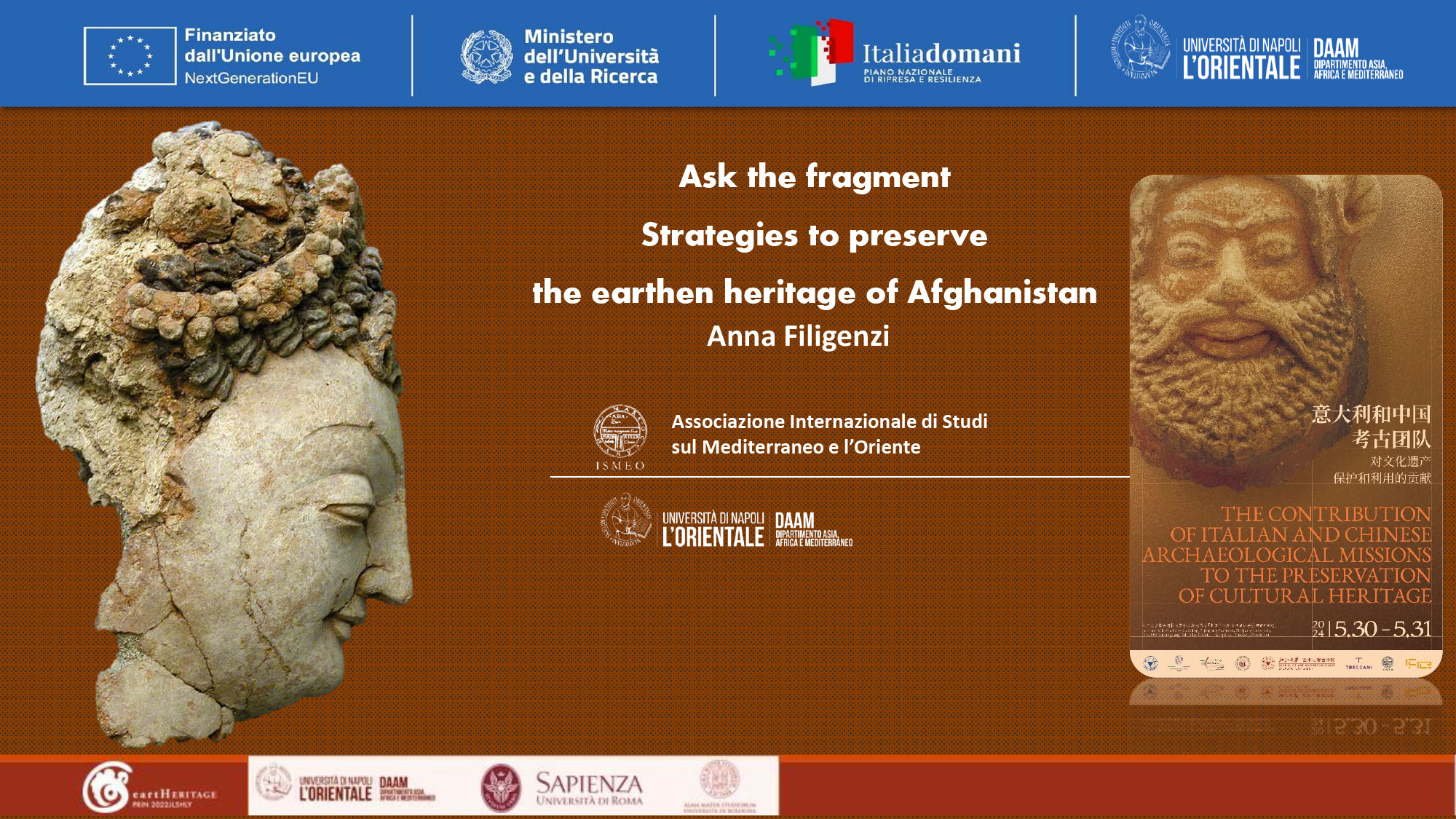
Abstract: The tangible archaeological heritage of pre-Islamic Afghanistan consists for the most part of perishable materials such as clay, stucco and wood. Over time, and in the absence of protection and care, these materials lose compactness, fragment and sometimes dissolve into forms that can no longer be reassembled. Besides the scant preservation of the remains, our knowledge of the art history of Afghanistan is hampered by several other factors, such as the insufficient documentation produced by outdated methods of archaeology in the early decades of the past century, the disruption in fieldwork due to political turmoil and instability that have affected the country since the late 1970s, the new upsurge of conflicts sparked in recent years by religious extremism, and the paucity of in-depth archaeological research in recent times. The poor preservation of the archaeological remains is further aggravated by the severe political and economic problems in the country. Caught in the grip of poverty and insecurity, a large part of Afghan civil society is totally disconnected from its cultural heritage. Furthermore, the lack of infrastructure and human resources has practically wiped out almost all cultural heritage-related activities and professionalism, thus making the management and protection of the latter substantially unsustainable. Therefore, despite its significance, this formidable cultural tradition, with its wealth of meanings and technical and material knowledge, remains only vaguely known and largely exposed to illegal excavations and black market, the latter also fostered by a thriving forgery industry. Wrong or superficial notions diffused by unfiltered media allow blatant counterfeits to enter museum galleries and pseudo-scientific literature, thus producing, in turn, a reiteration of biased ideas and stereotyped misconceptions. However, even under such unfavourable circumstances, much can be done, if not for the rescue of the physical objects, for the restitution of their original forms and contexts, as well as or the safeguarding of their intangible values. This contribution will illustrate some of the activities conducted by the Italian Archaeological Mission in Afghanistan of ISMEO, also in the framework of the PRIN Project 2022JL5HLY eartHeritage in favour of the Afghan cultural heritage. In addition to the necessary advancement of studies, the Italian Archaeological Mission has also chosen, as an ethical commitment, to dedicate part of its activities to the dissemination of knowledge to the general public, and in particular to the youngest generation of Afghans, through inclusive forms of distance education.