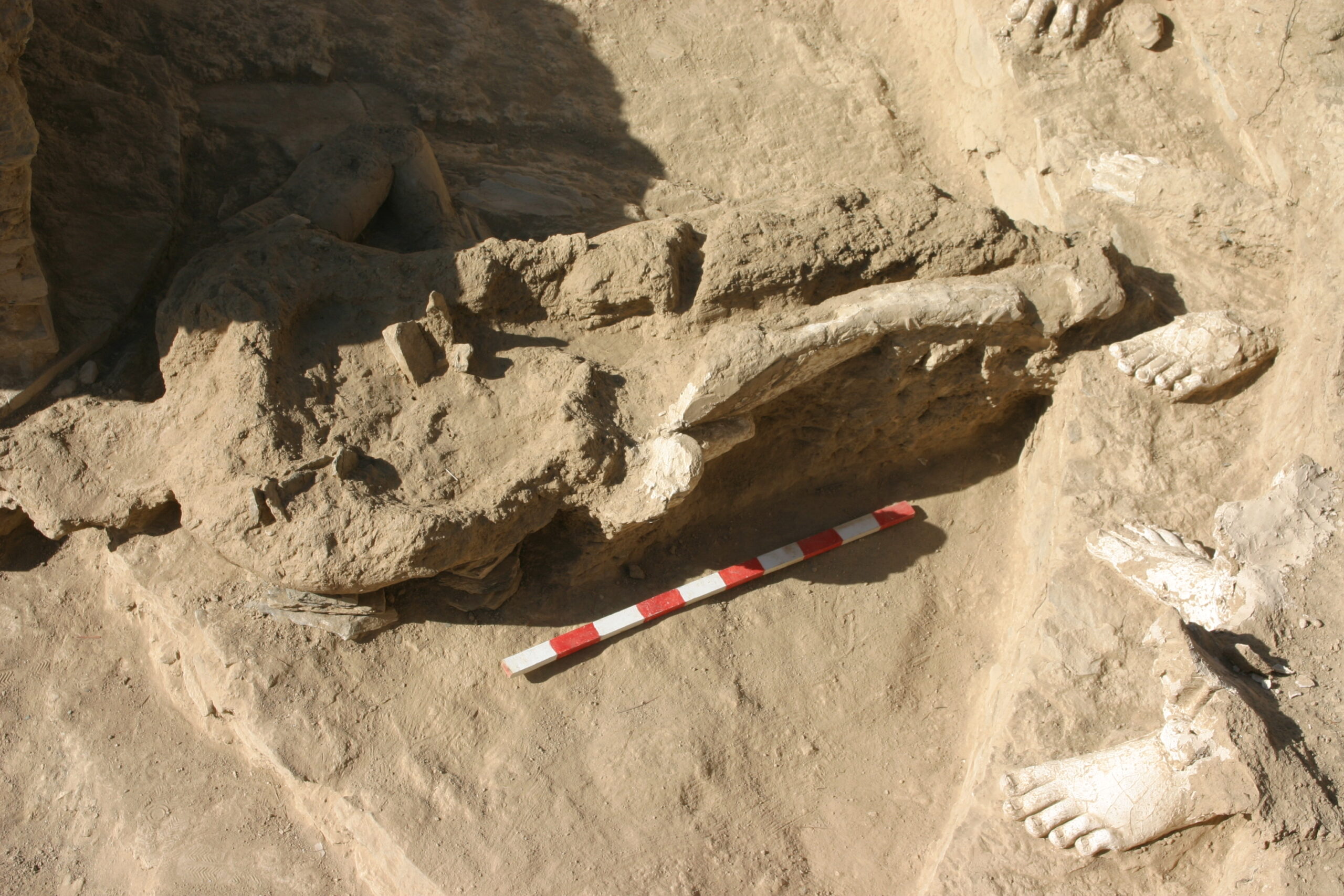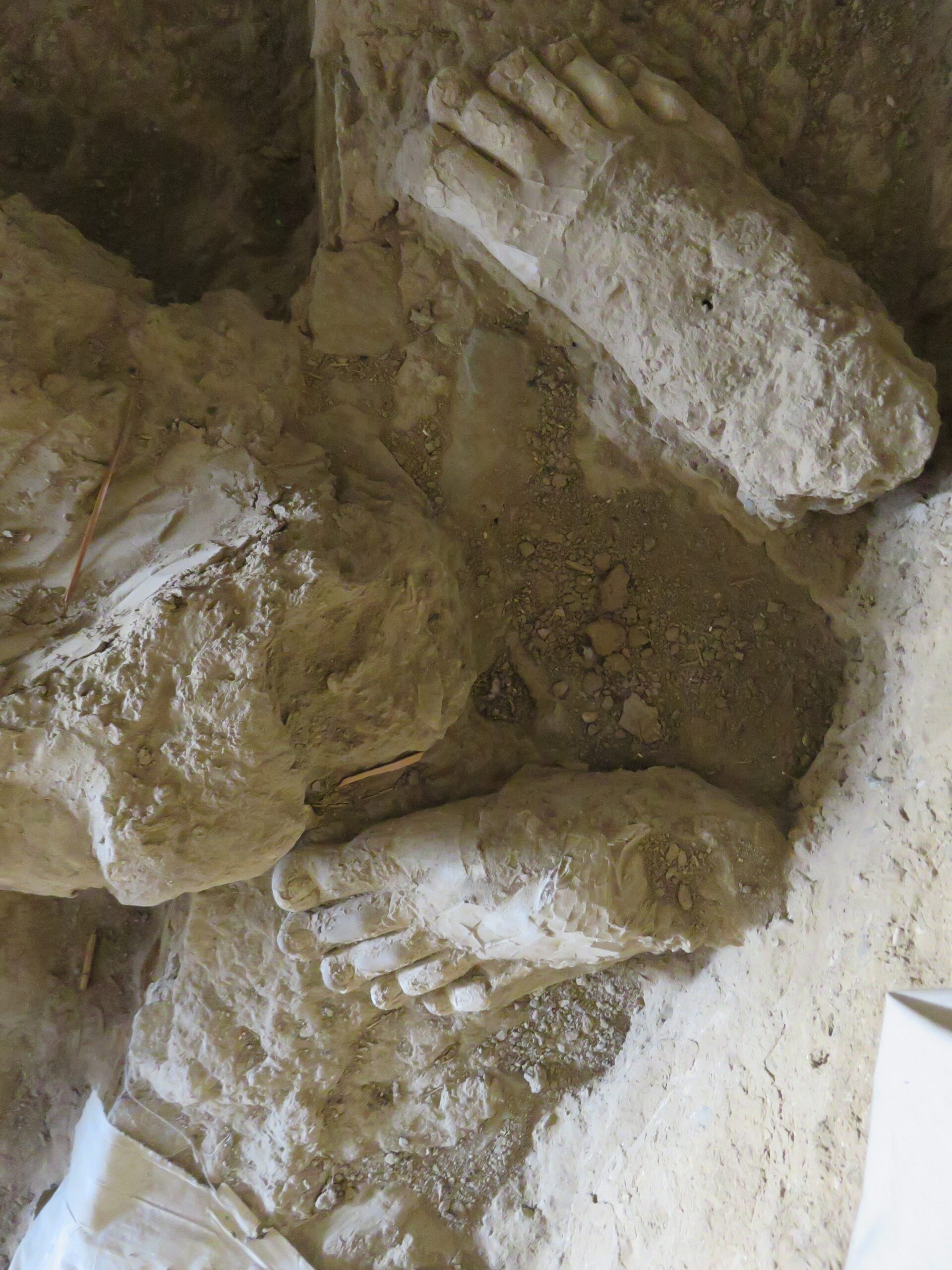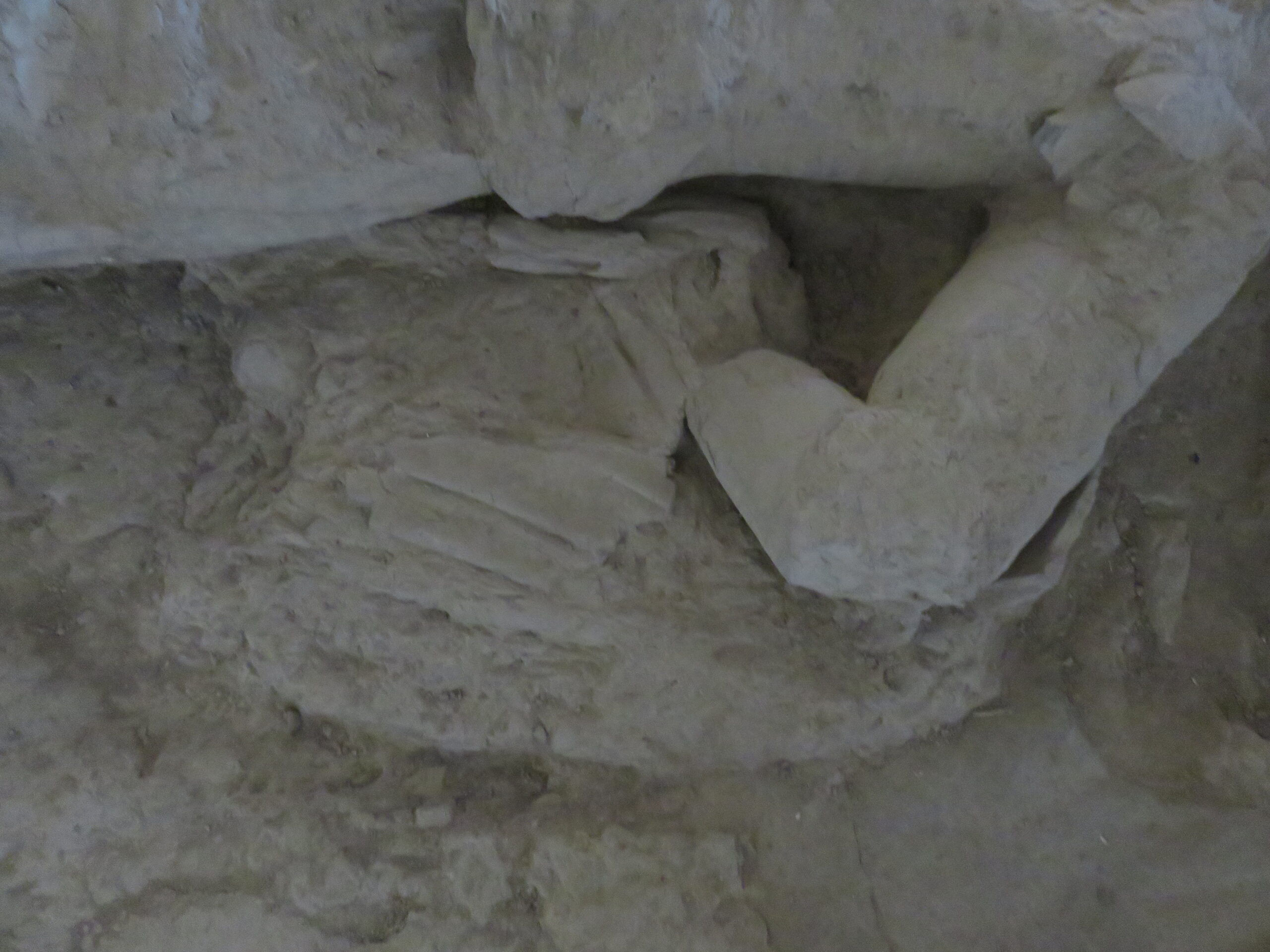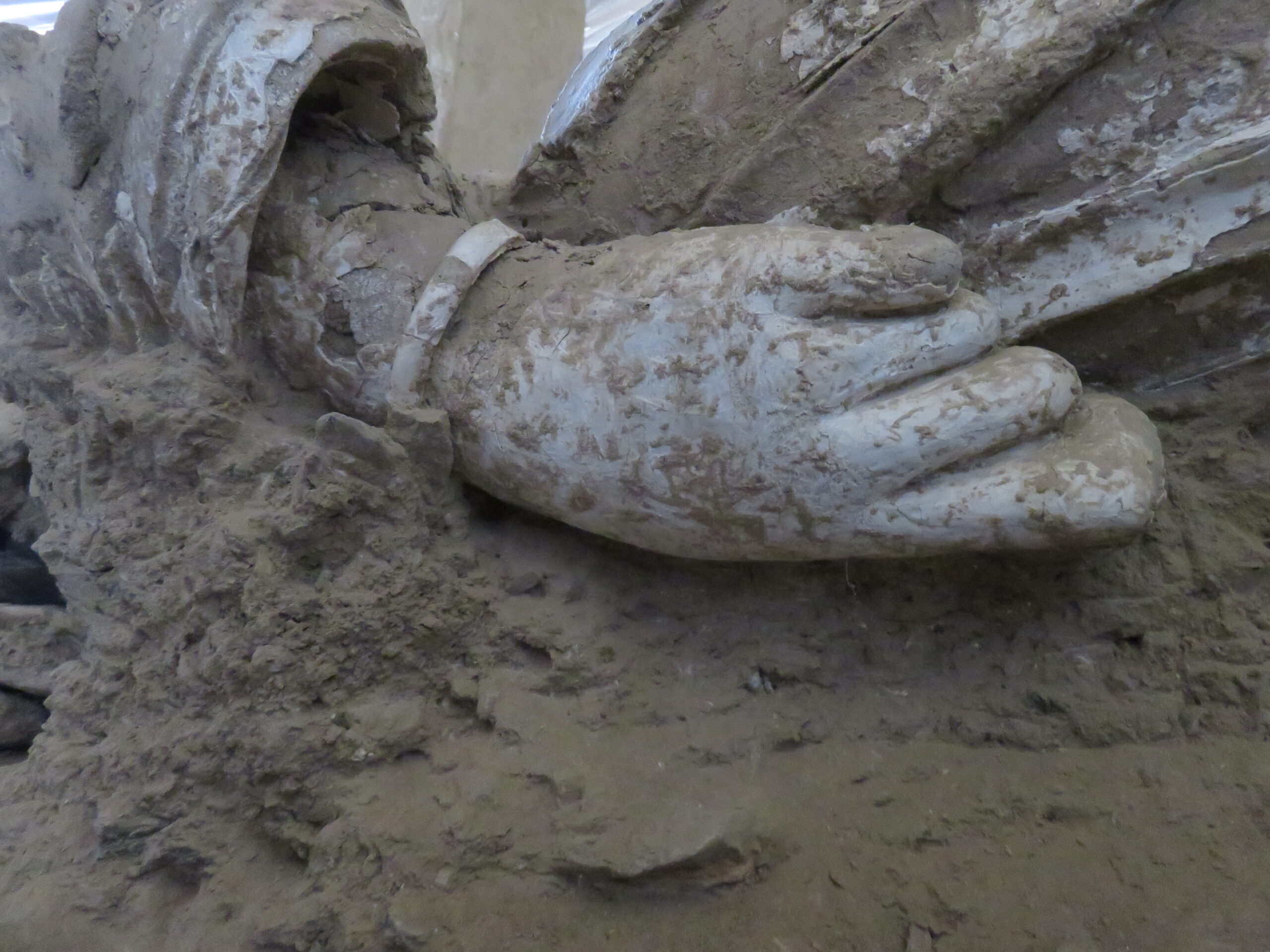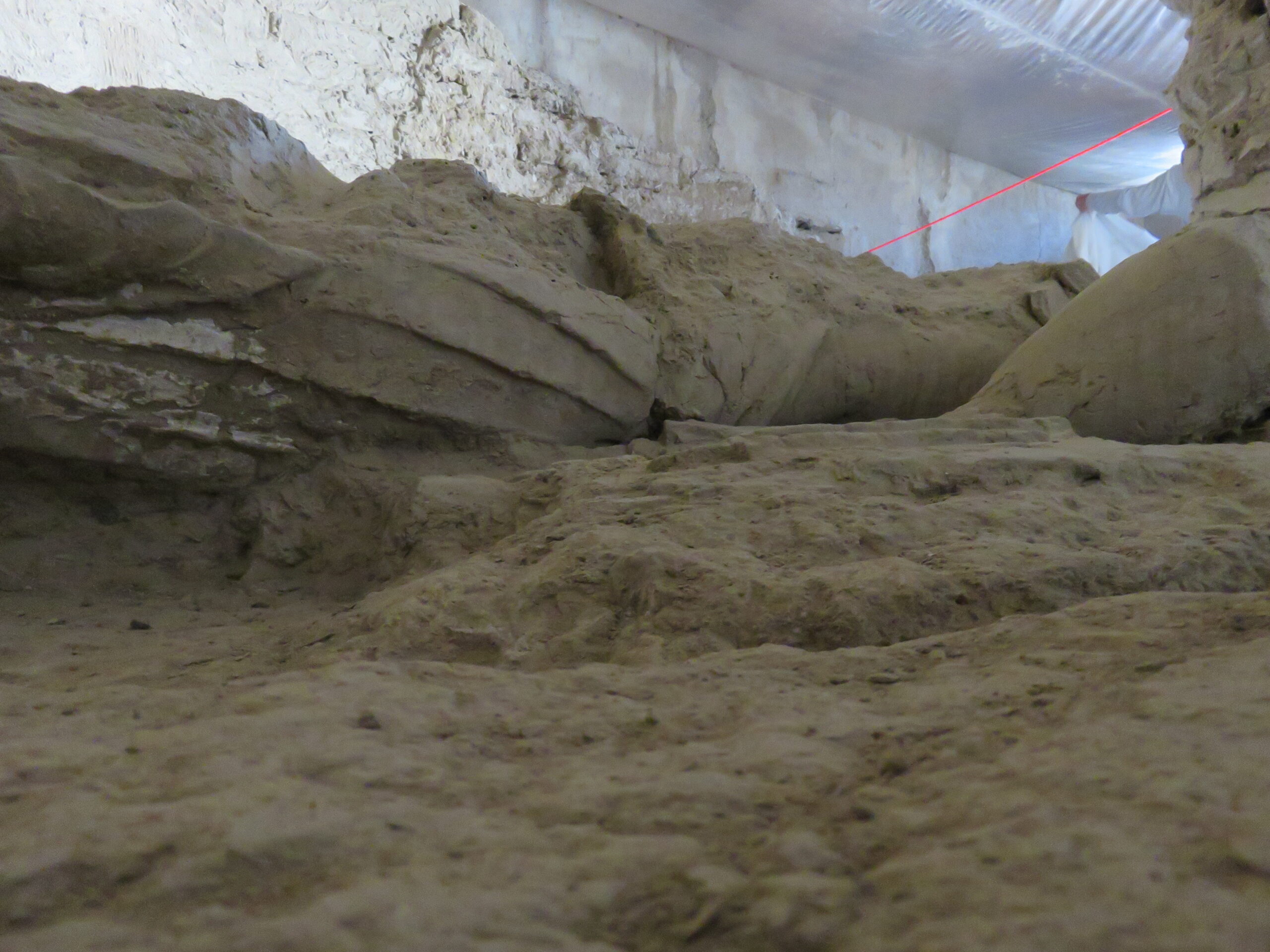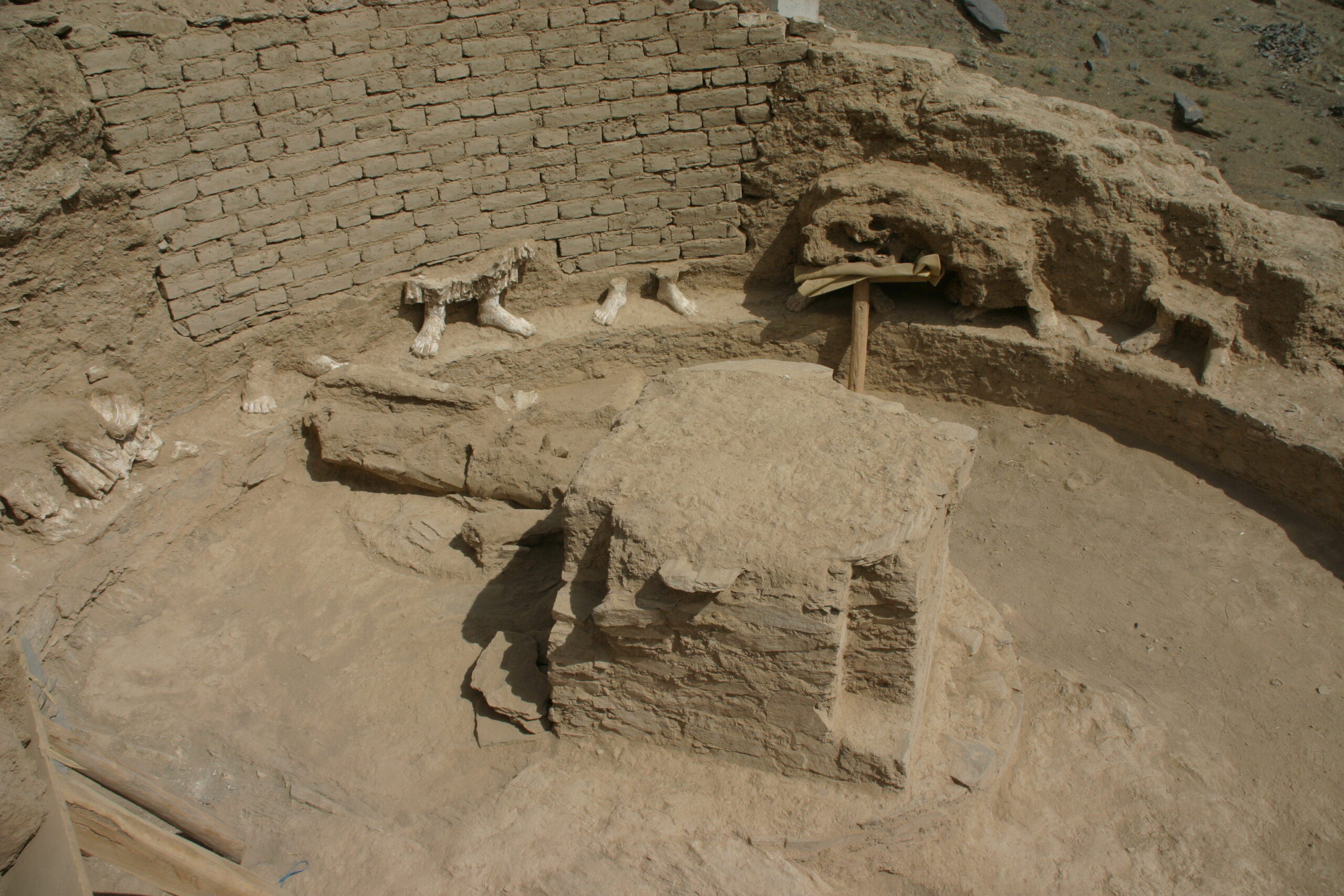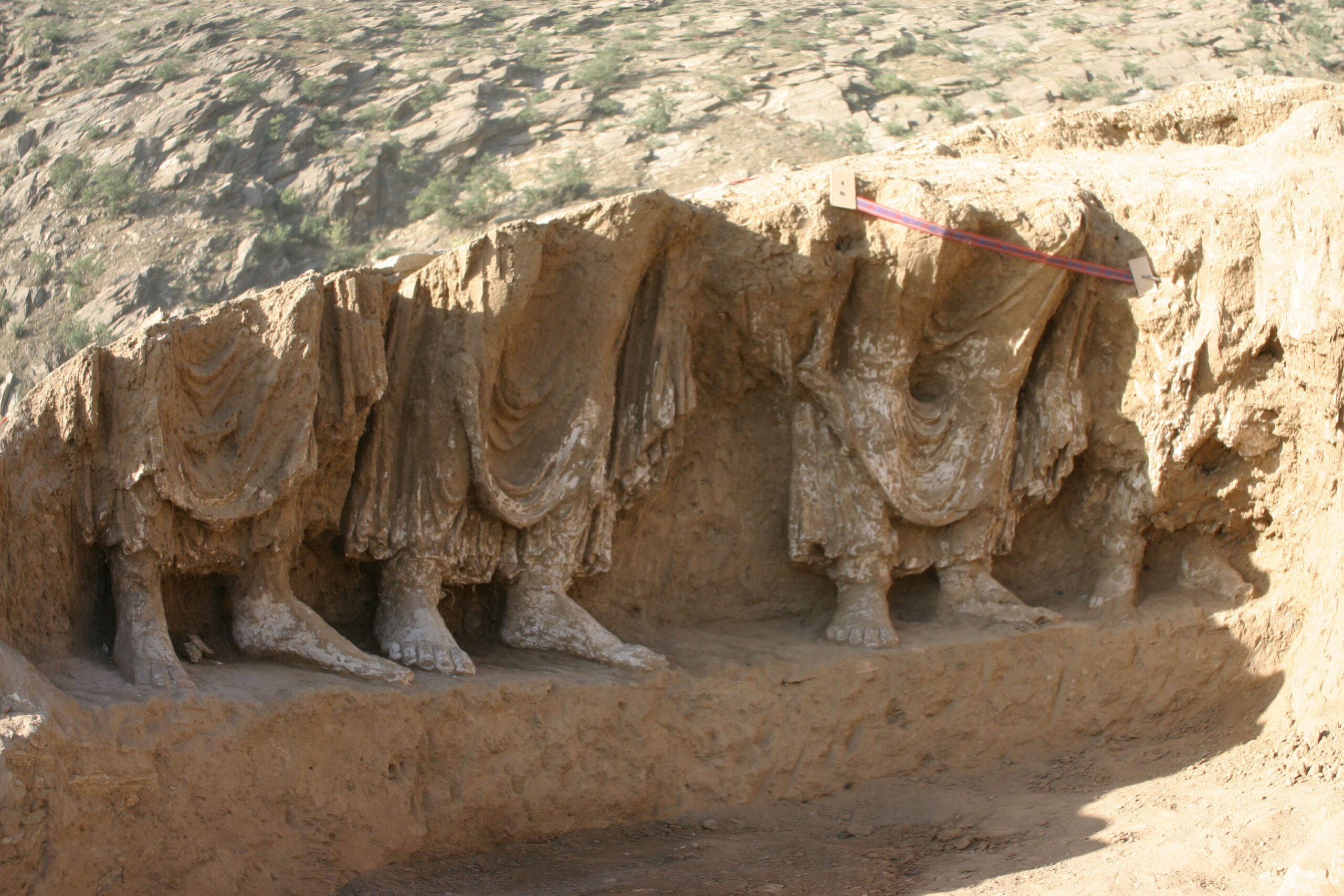
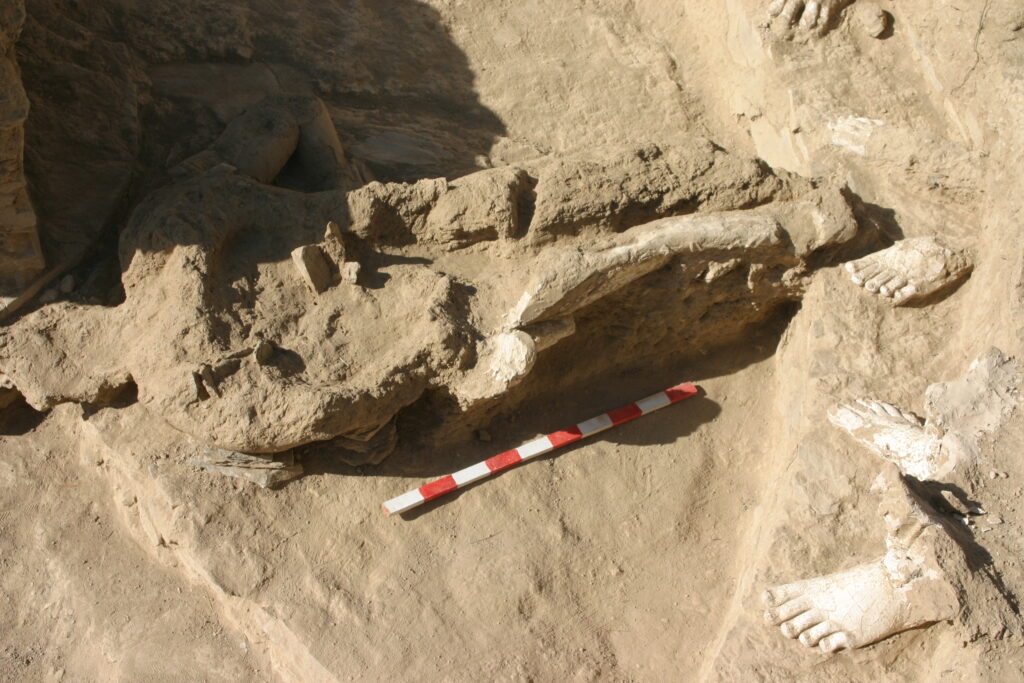
This over life-size standing bodhisattva was originally part of the sculptural decoration of the circular Chapel 4 at Tepe Narenj. Although the head is lost and the body is still lying face down in its original archaeological context, awaiting lifting and conservation, the preserved pose and drapery suggest that the bodhisattva was richly adorned and wore an uttariya over the left shoulder. The right hand was raised in abhayamudra, while the left hand would have held a kamandalu, identifying the figure as the bodhisattva Maitreya.
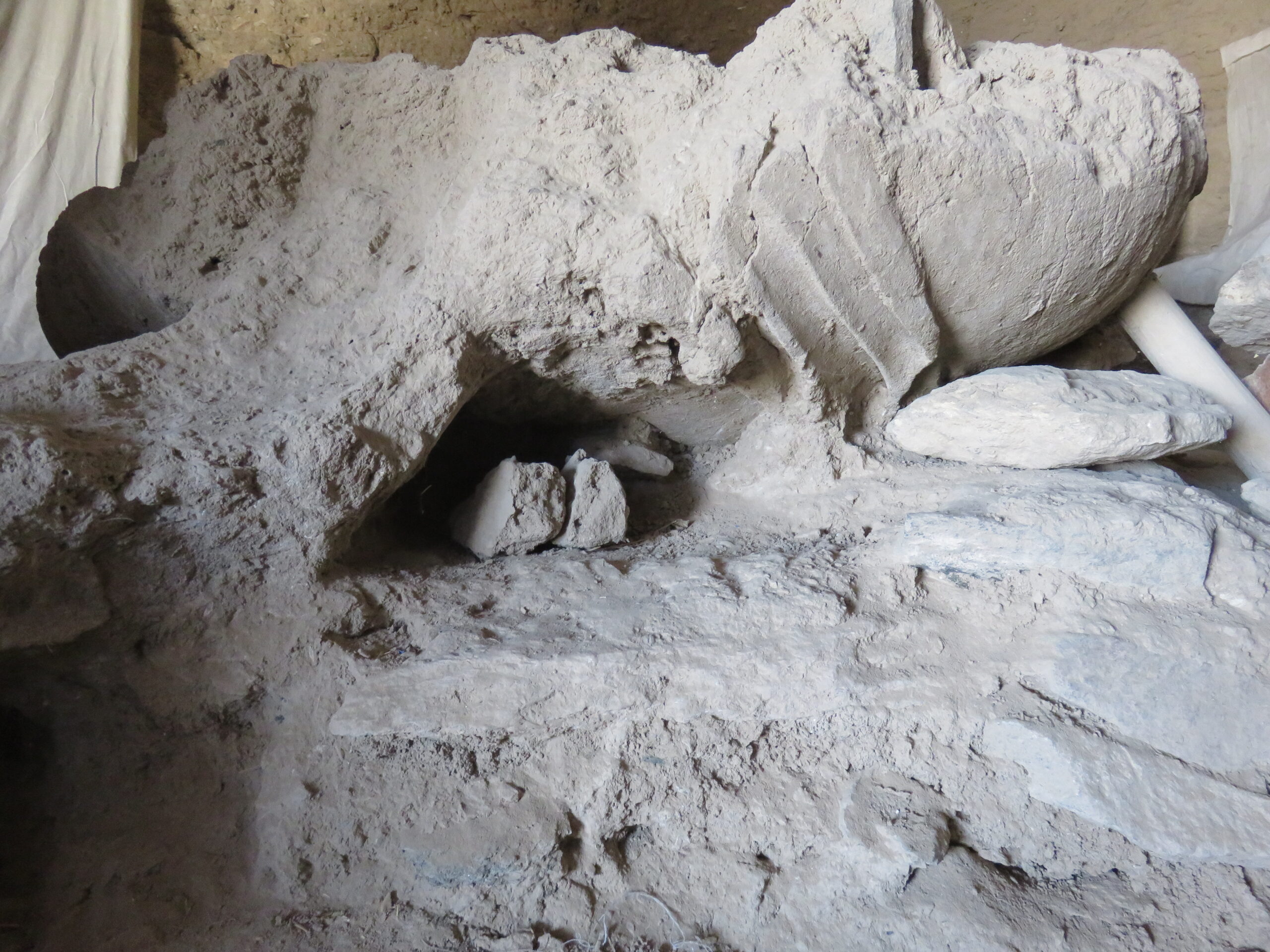
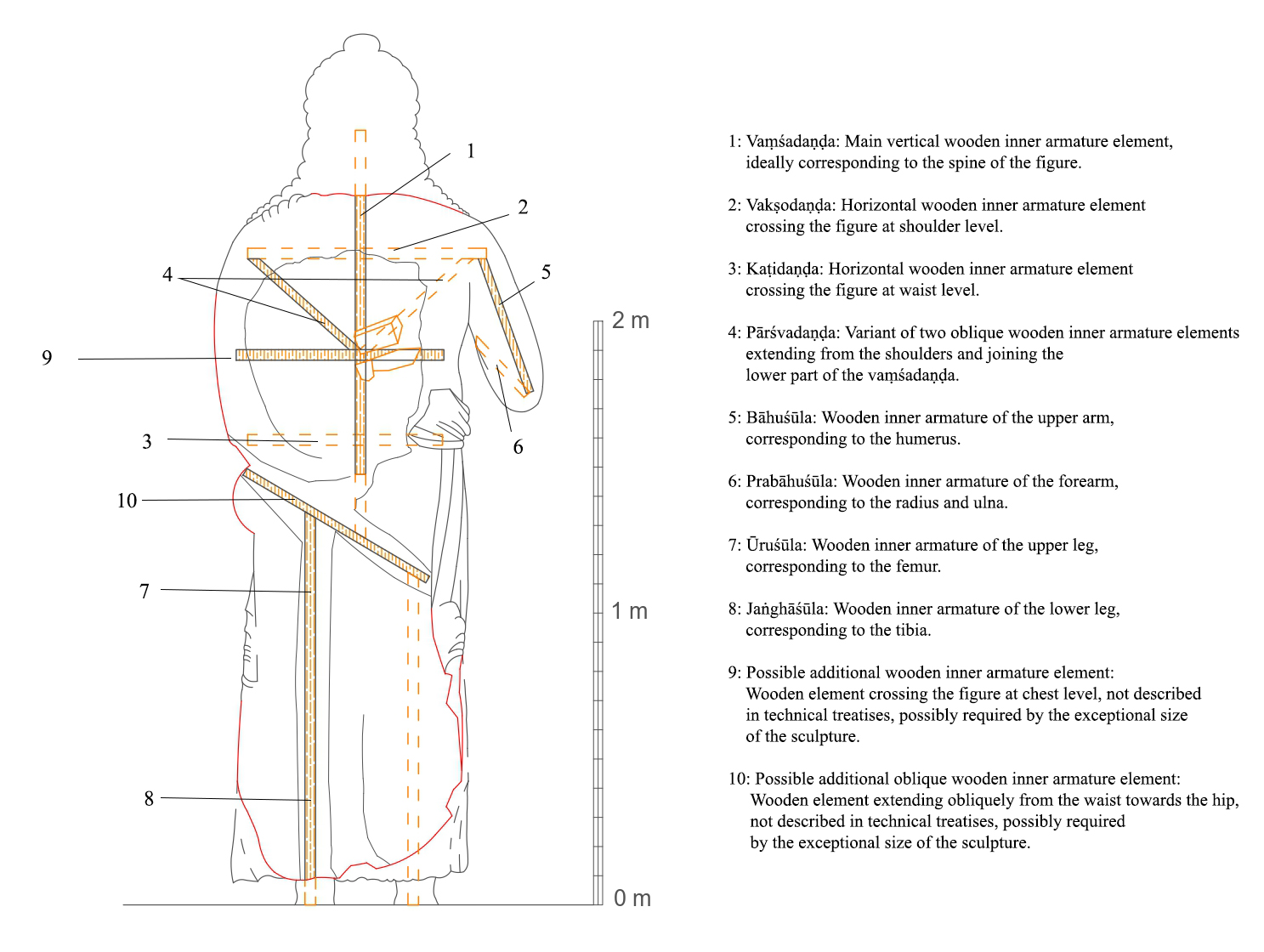
Equally significant evidence is preserved on the reverse of the sculpture. A series of elongated grooves and cavities reveal the decay of the original wooden armature embedded within the clay body. While its reconstruction remains hypothetical, these traces enable us to propose the arrangement of the internal wooden framework and the system used to anchor the sculpture to the back wall.
Technical treatises on sculptural practice describe the ideal configurations of internal supports that seeks to symbolically recreate the structure of the human body. This may be an integral part of the process of bringing the sculpture to life, which is so important in Indian religious culture. However, when compared with these textual models, the surviving material evidence reveals only partial correspondence, as well as additional elements and variations not mentioned in the written tradition.
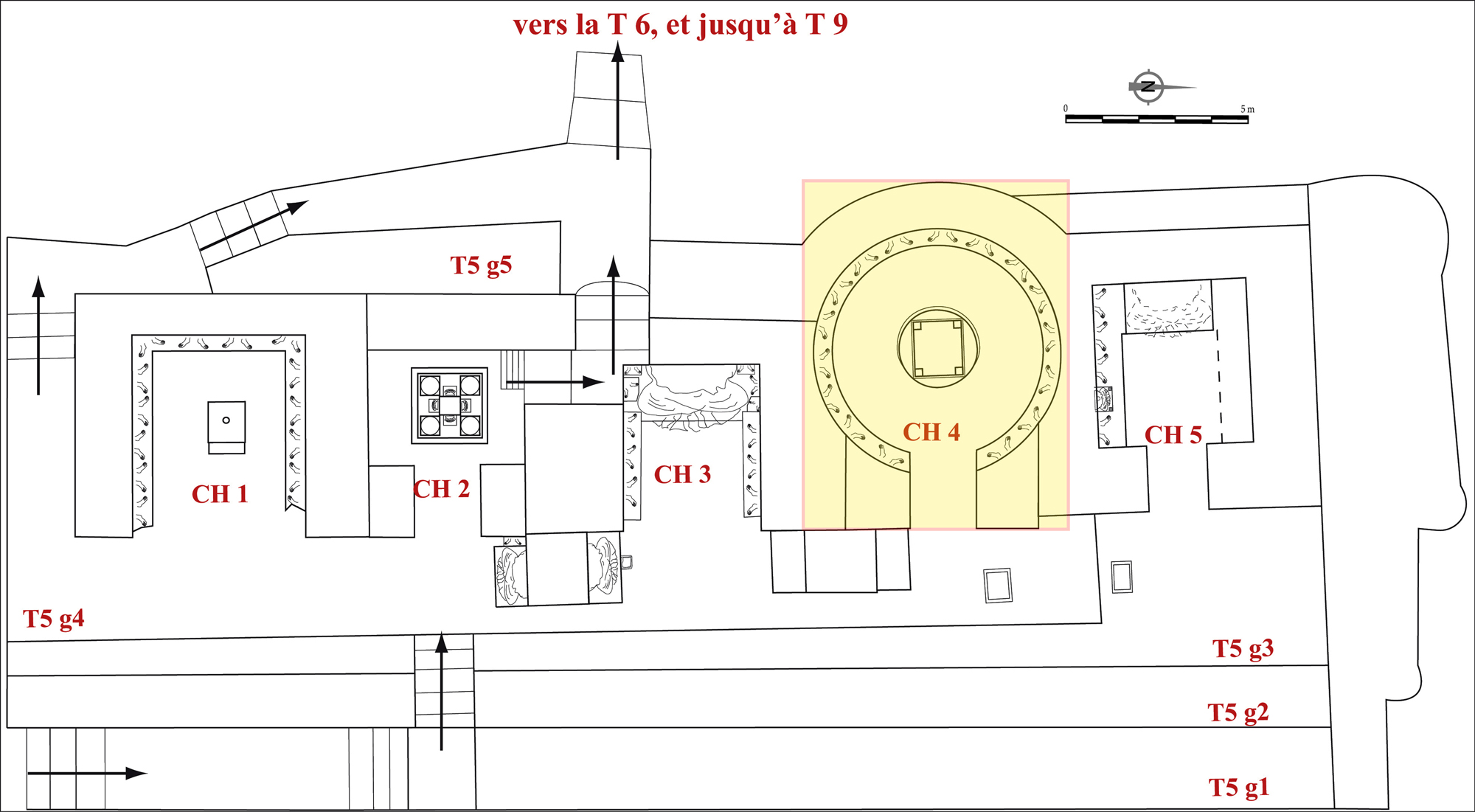
The sculpture was not conceived as an isolated image. It was part of a carefully planned ensemble of sixteen standing Buddhas and/or bodhisattvas figures fixed against the circular wall of the chapel, surrounding a lost central cult image. The number of figures, being a multiple of four, together with the circular architecture, probably symbolises the ordered cosmos, thus transforming the chapel into a sacred space structured according to Buddhist cosmological principles.
Indeed, Chapel 4 may be seen as an early three-dimensional representation of the mandala concept.
This sculptural programme also finds important parallels elsewhere in eastern Afghanistan. For instance, the Buddhist monastery of Kafiriat Tepe at Mes Aynak contained a quadrangular courtyard with a similar layout of standing bodhisattvas placed around a central space. One of the few documented figures appears to represent Maitreya, as indicated by the position of the hand that was originally holding a kamandalu. The sculptures from both sites were constructed using similar techniques, consisting of clay cores modelled with a white stucco coating. These similarities suggest that Tepe Narenj and Mes Aynak participated in a common artistic and religious tradition.
Although the fragile clay sculptures often survive only in fragmentary condition, they provide rare evidence for reconstructing the visual culture of Buddhist monasteries in Afghanistan between Late Antiquity and the early medieval period.