
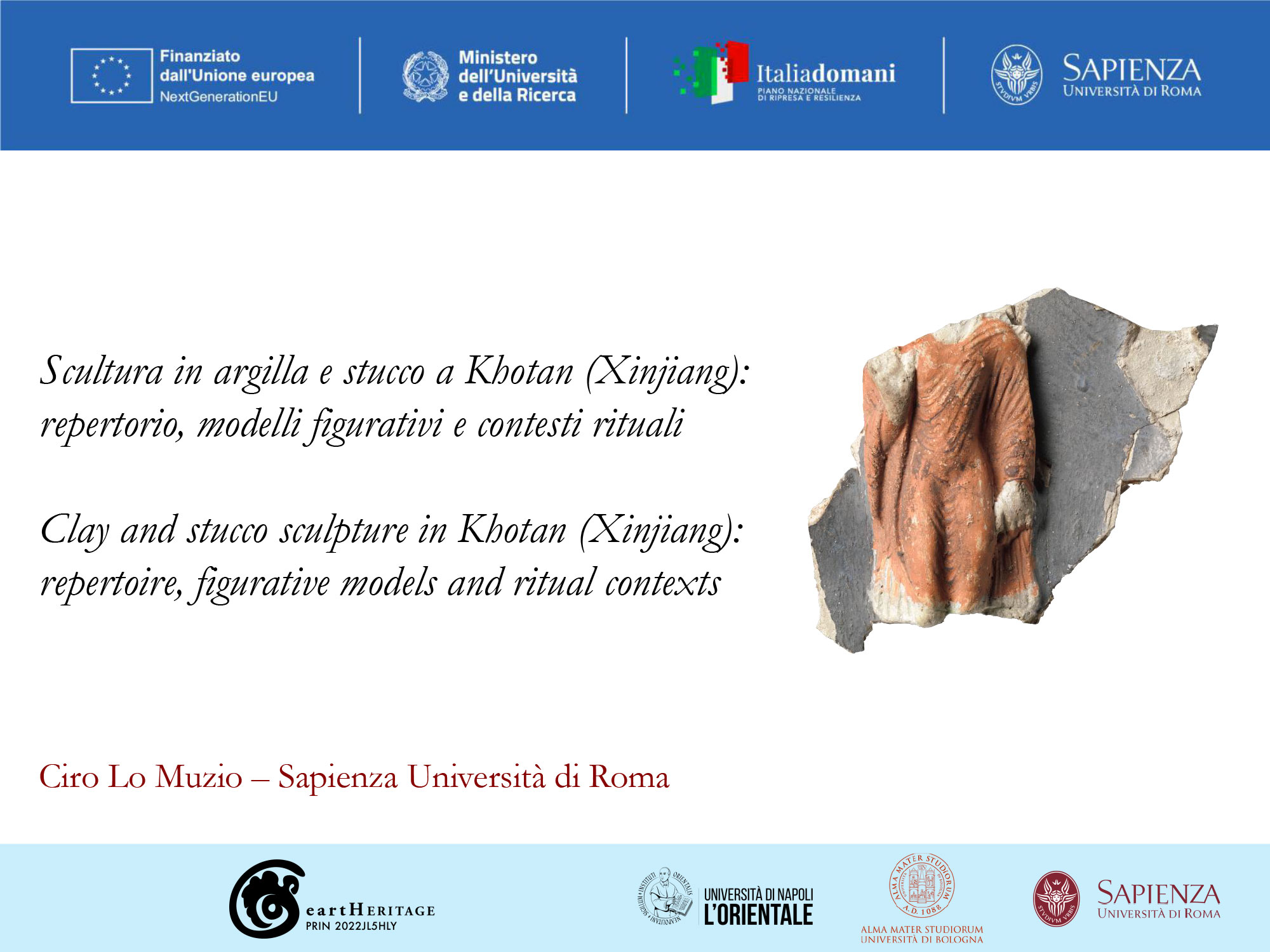
Abstract: Fatta eccezione per il sito di Rawak, che ha rivelato una ricca documentazione scultorea nel suo contesto originario, della scultura khotanese, realizzata quasi esclusivamente in argilla e stucco, abbiamo un quadro assai frammentario. Oltre allo stato di conservazione, a scoraggiare l’interesse degli studiosi verso questa materia potrebbero aver contribuito le eterogenee modalità di acquisizione dei reperti, buona parte dei quali è decontestualizzata. Eppure, varrebbe la pena moltiplicare gli sforzi, considerato che, tanto nell’oasi di Khotan quanto in altre regioni dell’Asia buddhista, il fulcro dello spazio rituale era rappresentato da una scultura, o da un insieme gerarchico di sculture, mentre alla pittura murale, che a Khotan è più ampiamente documentata e indagata, era assegnato un ruolo complementare. Inoltre, a Khotan come altrove nel Bacino del Tarim (Xinjiang), la scultura ha un grande potenziale, non ancora pienamente sfruttato, per lo studio dei contatti con altre regioni, sul piano artistico e religioso, e per il loro inquadramento cronologico. Oltre allo stato della ricerca su queste tematiche, si darà spazio a una riflessione sui contesti architettonici del culto buddhista nell’oasi di Khotan, in particolare sul contrasto tra il quadro presentato dalle fonti scritte e quello sinora rivelato dalla ricerca archeologica.
With the exception of the Rawak site, which revealed a rich documentation in context (soon deliberately covered with sand again), the record of Khotanese clay and stucco sculpture is quite fragmentary. In addition to the state of preservation, the heterogeneous nature of the finds, many of which are decontextualised, may have contributed to the lack of scholarly interest in the subject. Still, it would be worthwhile to multiply the efforts, considering that in the Khotan oasis as well as in other regions of Buddhist Asia, the focus of ritual space was represented by a sculpture, or a hierarchical set of sculptures, while wall painting, which is more extensively documented and investigated in Khotan, played a complementary role. Furthermore, in Khotan as elsewhere in the Tarim Basin (Xinjiang), sculpture has great potential, not yet fully exploited, for the study of contacts with other regions, on an artistic and religious level, and for their chronological framing. In addition to outlining the state of research on these issues, space will be given to some remarks on the architectural contexts of Buddhist worship in the Khotan oasis, and the contrast between the scenario provided by written sources and that so far revealed by archaeological research.