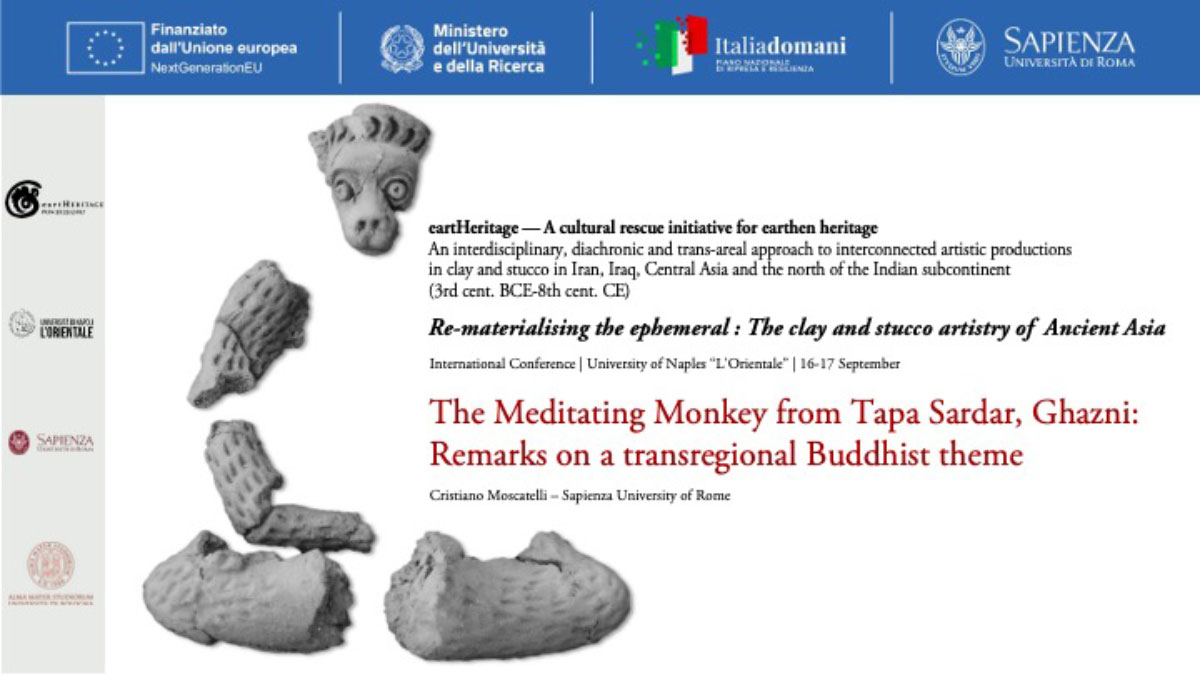
Abstract: Among the clay sculptures excavated at the Buddhist site of Tapa Sardar (Ghazni, Afghanistan) by the Italian Archaeological Mission, two meditating monkeys are particularly noteworthy. These monkeys belonged, respectively, to the decorative programs of Chapels 23 and 37 (Main Stūpa terrace), both centred on an epiphanic image of the Buddha and datable to around the 7th-8th century CE. Meditating monkeys first appear in Gandharan stone sculpture, particularly in scenes illustrating the visit of Indra to the Buddha meditating in a cave. Later, they recur not only at Tapa Sardar and other Buddhist centres in Central Asia, but also in the painted decorations of the Kucha caves (Xinjiang), showing a wide diffusion and persistence of this motif across Buddhist regions from roughly the mid- to late 1st millennium CE. Following an overview of these figurative contexts, with special focus on Tapa Sardar, this contribution examines the motif of the meditating monkey in light of Buddhist textual traditions. Texts of diverse nature depict this animal as a metaphor for the human mind, prone to corruption and desire, yet capable of discipline, renewal, and spiritual growth. As such, the monkey embodies a doctrinal narrative of the human path toward enlightenment.