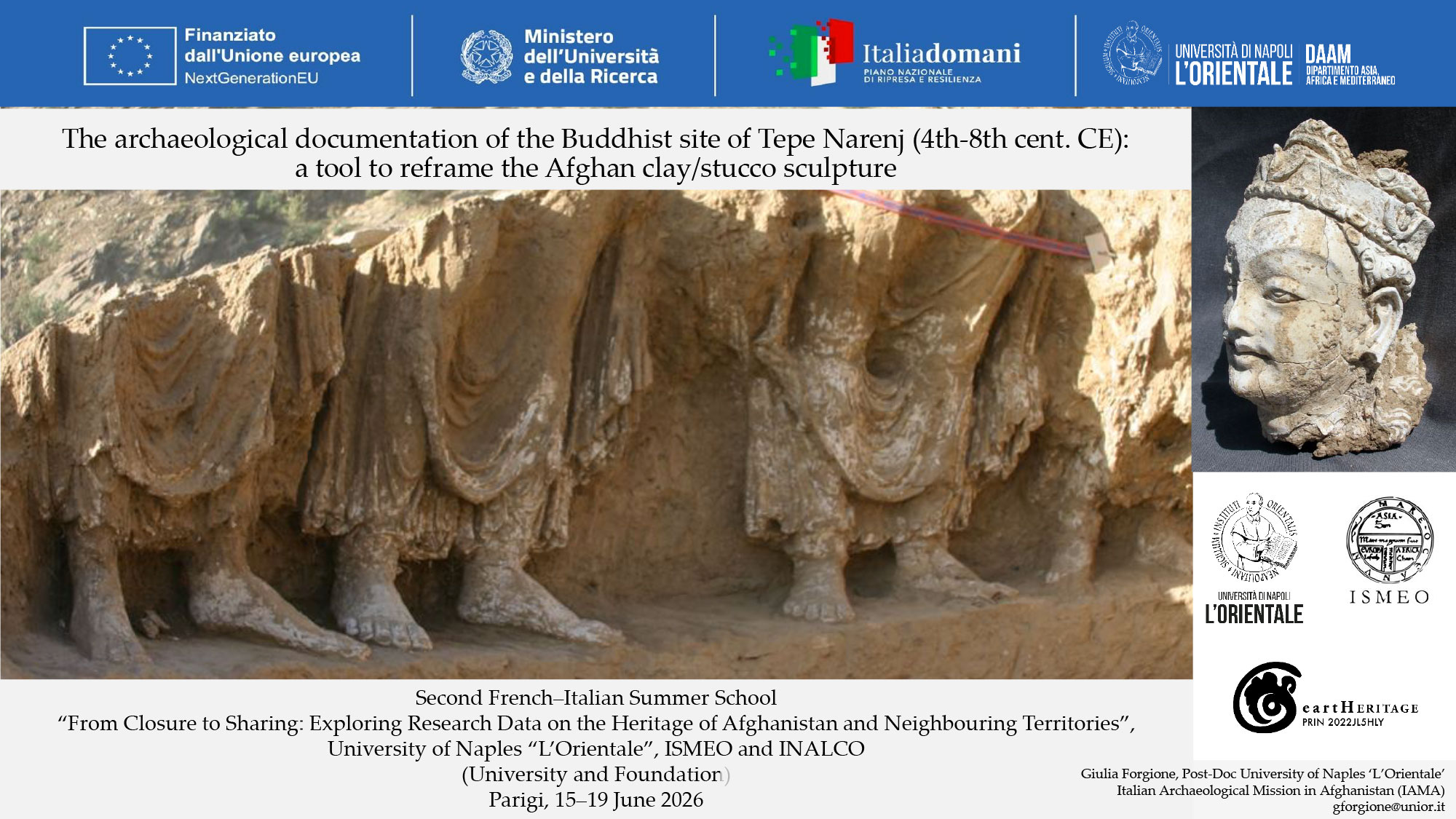
Abstract: This paper presents the archaeological site of Tepe Narenj, a Buddhist monastic complex located in the Kabul region and excavated by the Archaeology Institute of Afghanistan under the direction of Zafar Paiman. Thanks to the exceptional preservation of its architecture, sculptures, paintings, and archaeological contexts, Tepe Narenj represents one of the most important discoveries for the study of Buddhism in Late Antique Afghanistan. The paper examines the archaeological documentation produced during the excavations and discusses the site’s contribution to the reconstruction of the historical, artistic, and religious landscape of eastern Afghanistan between the 4th and 8th centuries CE. Particular attention is devoted to the sculptural assemblage, which provides valuable evidence for workshop practices, material technologies, and visual culture. Through comparisons with sites such as Hadda and Tapa Sardar, Tepe Narenj emerges as a key reference point for reassessing artistic developments in the Kabul region and their place within the broader Buddhist world of Afghanistan and Central Asia.