
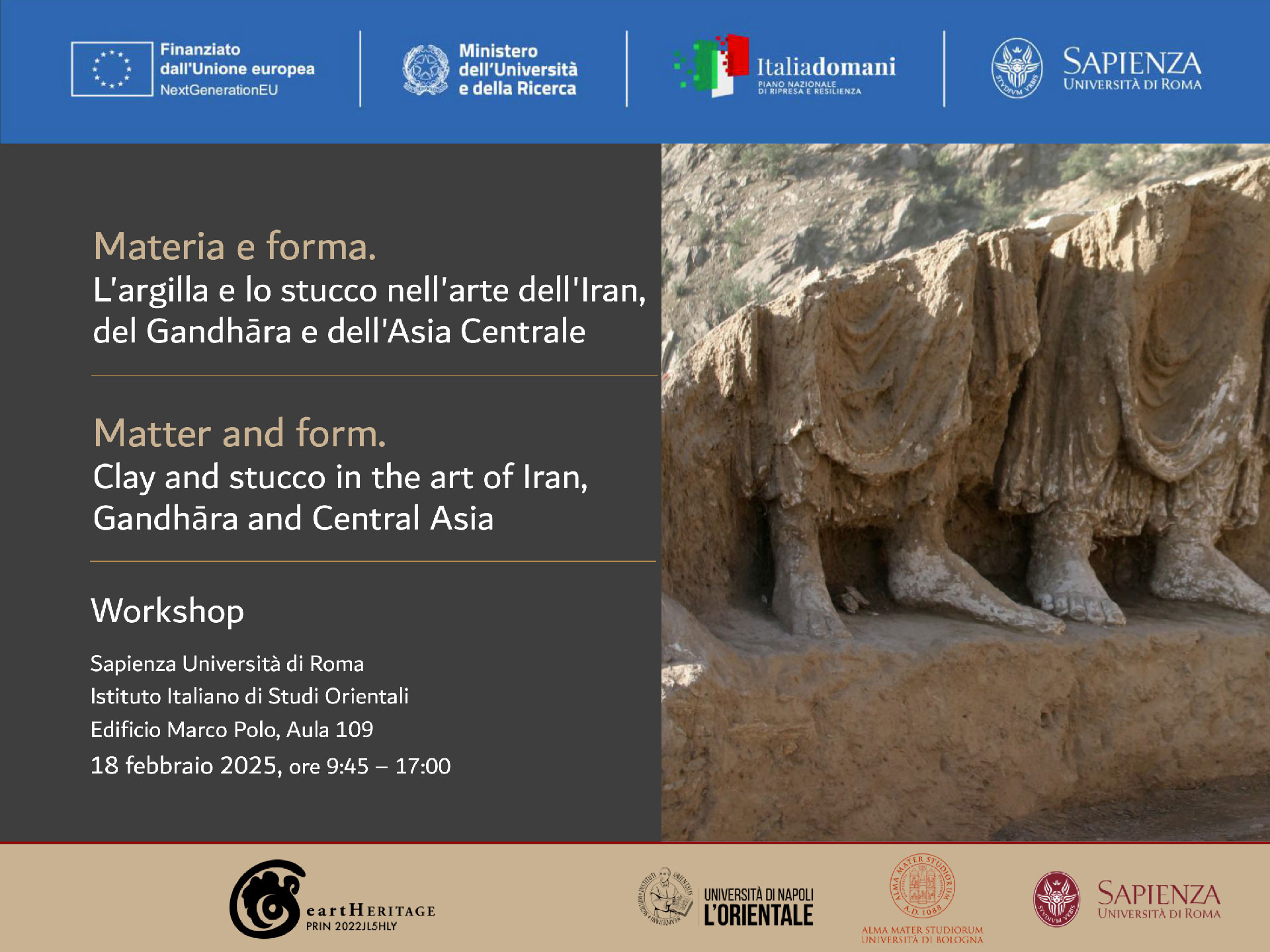
Materia e forma.
L’argilla e lo stucco nell’arte dell’Iran, del Gandhāra e dell’Asia Centrale
Matter and form.
Clay and stucco in the art of Iran, Gandhāra and Central Asia
Workshop – 18 febbraio 2025
Sapienza Università di Roma – Istituto Italiano di Studi Orientali
Edificio Marco Polo, Aula 109
ore 9:45 – 17:00
Abstracts
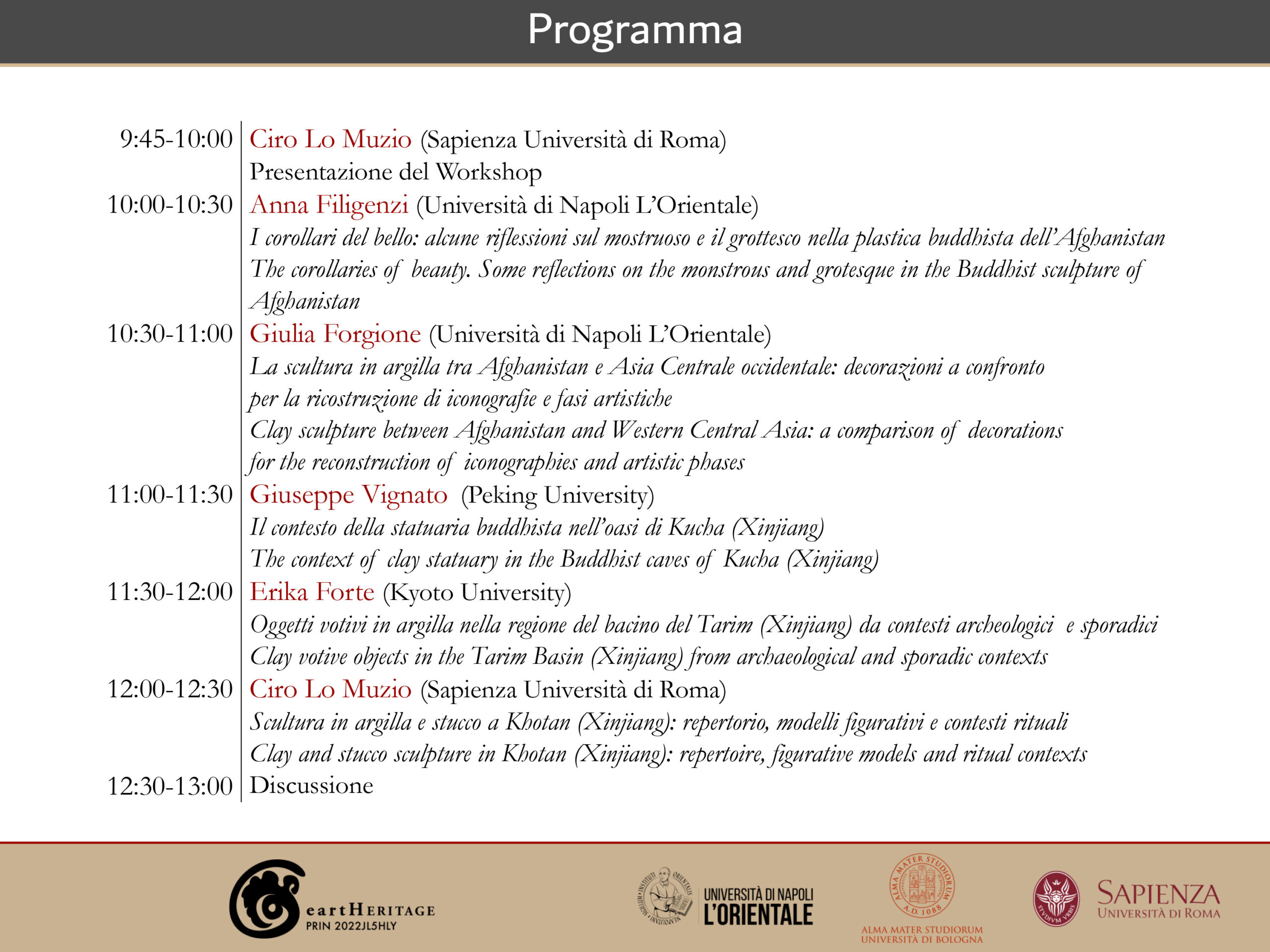
Anna Filigenzi (Università di Napoli L’Orientale)
I corollari del bello: alcune riflessioni sul mostruoso e il grottesco nella plastica buddhista dell’Afghanistan
La letteratura e le arti visive ci forniscono materia sufficiente per indagare lo stretto rapporto che il buddhismo stabilisce tra bellezza fisica e bellezza morale. Nella visione karmica, che si dispiega nel tempo dilatato di vite multiple, la pratica delle virtù ha un potere trasformativo sulla complessione fisica. Lo stesso corpo del Buddha, di vita in vita, diviene più bello, più forte, più sano. La sua bellezza è testimonianza non falsificabile dei traguardi spirituali raggiunti, ma allo stesso tempo anche uno strumento cognitivo, di conversione e ispirazione, che agisce sull’osservatore suscitando un desiderio sincero di emulazione. Dalla concezione normativa del “corpo virtuoso” per eccellenza ‒ ovvero quello del Buddha ‒ e della sua bellezza nascono, per opposizione, i corollari di anomalie in cui si manifestano gli effetti karmici di errori passati, ma anche una vasta gamma di “corpi virtuosi” che si pongono all’interno di una scala differenziata di meriti. In questo contributo, si tenterà di rintracciare i riflessi di tali nozioni sulla produzione artistica afghana, che per la sua lunga continuità temporale consente di osservare anche i mutamenti dei codici estetici e dei repertori iconografici attraverso i quali esse prendevano forma, intrecciandosi con vecchi e nuovi paradigmi culturali.
The corollaries of beauty. Some reflections on the monstrous and grotesque in the Buddhist sculpture of Afghanistan
Literature and the visual arts provide us with sufficient material to investigate the close relationship that Buddhism establishes between physical beauty and moral beauty. In the karmic vision, which unfolds in the measureless time of multiple lives, the practice of virtues has transformative effects on the physical complexion. The Buddha’s own body, from life to life, becomes more beautiful, stronger, healthier. Its beauty is an unfalsifiable testimony of spiritual achievements and, at the same time, a cognitive tool that converts and inspires, by arousing in the observer a sincere desire to emulate. From the normative conception of the ‘virtuous body’ par excellence – i.e. that of the Buddha – and its beauty arise, by way of opposition, the corollaries of anomalies that reflect the karmic effects of past errors, but also a wide range of ‘virtuous bodies’ that are placed within a differentiated scale of merits. In this contribution, an attempt will be made to trace the reverberations of such notions in Afghan artistic production, which, due to its centuries-long continuity, also allows us to observe the changes in the aesthetic codes and iconographic repertoires through which they took shape, intertwining with old and new cultural paradigms.
Giulia Forgione (Università di Napoli L’Orientale)
La scultura in argilla tra Afghanistan e Asia Centrale occidentale: decorazioni a confronto per la ricostruzione di iconografie e fasi artistiche
La scultura in argilla in Afghanistan rappresenta un campo ancora molto poco esplorato dal punto di vista stilistico, tecnico e materiale. Spesso, a causa della mancanza di dati archeologici affidabili, la restituzione di una cronologia assoluta e la ricostruzione di fasi artistiche è possibile solo in rari casi. Tra questi, si può annoverare il sito buddhista di Tapa Sardar (Afghanistan) che, con la sua stratigrafia, ci consente di collegare il vasto corpus di sculture qui rinvenuto ad una sequenza relativa ben definita e di rintracciare delle linee guida su cui basare confronti con altri materiali. Questi si limitano tuttavia a considerazioni di tipo stilistico, prive del supporto di solidi dati archeologici.
Anche la frammentarietà delle evidenze pone non pochi problemi sugli aspetti tecnici e materiali. Inoltre, la modellazione dell’argilla si serve non solo di diversi materiali deperibili, ma anche di tecniche che, pur uguali nel concetto, possono variare nell’applicazione in base ai singoli casi o parti da rappresentare.
Questo studio prende in considerazione solo la decorazione applicata, ottenuta dalla lavorazione separata di piccoli dettagli realizzati a stampo che poi vengono fatti aderire alla superficie dell’opera. Certamente ispirati a ornamenti che erano realmente in uso, questi motivi decorativi diventano caratterizzanti di certe produzioni.
Mentre in alcuni studi precedenti l’analisi si è focalizzata su placchette decorative di un periodo relativamente tardo, principalmente dal sito di Tapa Sardar, questa volta l’attenzione è posta su alcune tipologie documentate nel periodo antico dello stesso sito e sui confronti che si possono rintracciare in altri siti, quali Mes Aynak e Tepe Maranjan in Afghanistan e Dalverzin Tepe in Uzbekistan.
Clay sculpture between Afghanistan and Western Central Asia:
a comparison of decorations for the reconstruction of iconographies and artistic phases
Afghan clay sculpture is a field that remains underexplored from the stylistic, technical and material perspective. The lack of reliable archaeological data often prevents the restitution of an absolute and relative chronology. As a result, the reconstruction of artistic phases is only rarely possible. An exception is the Buddhist site of Tapa Sardar (Afghanistan), whose stratigraphy enables us to connect the vast corpus of sculptures found here to a well-defined relative sequence, from which we can also derive some guidelines for comparisons with other materials. However, these are limited to stylistic considerations lacking supporting archaeological evidence.
The fragmentary nature of the remains also poses quite a few problems with regards to technical and material aspects. Furthermore, the clay modelling makes use not only of different perishable materials, but also of techniques that, although the same in concept, may vary in their application depending on the specific cases or parts to be represented.
This study only focuses the applied decoration, obtained from the separate processing of small, moulded details that were then applied to the surface of the sculptures. Inspired by ornaments that were actually in use, these decorative motifs became distinctive features of certain productions.
Whereas in previous studies the analysis focused on decorative plaques from a relatively “Late Period”, mainly from Tapa Sardar, this time the focus is on some types documented in the “Early Period” from the same site and the comparisons that can be found in other sites, such as Mes Aynak and Tepe Maranjan in Afghanistan and Dalverzin Tepe in Uzbekistan.
Giuseppe Vignato (Peking University)
Il contesto della statuaria buddhista nell’oasi di Kucha (Xinjiang)
Le grotte buddhiste di Kucha sono note per i loro dipinti, da oltre un secolo oggetto di studi approfonditi. L’iconografia delle pitture è conosciuta, ma un fattore cruciale è spesso trascurato: il fulcro del programma iconografico delle grotte decorate – ossia tutte le grotte a pilastro centrale, la grande maggioranza delle grotte a pianta quadrata, e le nicchie – era una scultura. Di tali statue di culto non si sono conservati che pochissimi frammenti, all’interno delle grotte, e altre parti frammentarie, per la maggior parte teste di Buddha e Bodhisattva, attualmente conservate nei musei d’Europa, d’America e dell’Estremo Oriente.
I reperti delle collezioni museali possono essere studiati dal punto di vista dell’iconografia, del materiale e della tecnica, ma non da quello della loro funzione all’interno delle grotte. Il mio contributo si pone l’obiettivo di ricollocare idealmente le statue nelle loro posizioni originarie, in base all’analisi dei segni di installazione visibili nelle pareti delle grotte. Una volta restituite al loro contesto, le sculture consentiranno una più corretta interpretazione dell’aspetto delle grotte, al tempo del loro utilizzo, e del loro programma iconografico.
The context of clay statuary in the Buddhist caves of Kucha (Xinjiang)
The Buddhist caves of Kucha are known for their paintings, which have been the subject of extensive studies for more than a century. The iconography of the paintings is well known, but one crucial factor is often overlooked: the fulcrum of the iconographic programme of the decorated caves – that is all the central pillar caves, the vast majority of the square caves, and the niches – was a sculpture. Only very few fragments of these cult statues have been preserved within the caves, while more fragments, mostly heads of Buddhas and Bodhisattvas, are now preserved in museums in Europe, America and the Far East.
The finds in museum collections can be studied from the point of view of iconography, material and technique, but not from that of their function within the caves. My contribution aims to ideally relocate the statues in their original positions, based on the analysis of the installation marks visible in the cave walls. Once re-contextualised, the sculptures will allow for a more correct interpretation of the appearance of the caves at the time of their use and their iconographic programme.
Erika Forte (Kyoto University)
Oggetti votivi in argilla nella regione del bacino del Tarim (Xinjiang) da contesti archeologici e sporadici
La produzione e l’uso di placche votive in argilla in India e Tibet sono stati ampiamente documentati e studiati, grazie all’abbondanza di prove disponibili. Al contrario, l’Asia centrale orientale presenta un quadro differente, in cui gli oggetti votivi in argilla stampati e modellati sono rimasti poco esplorati. Le collezioni museali, i cataloghi di mostre e la letteratura accademica forniscono solo riferimenti frammentari a questi manufatti, creando l’impressione di una loro scarsità e suggerendo che la pratica della modellazione di immagini in argilla, centrale nelle pratiche del buddhismo mahāyāna in tutta l’Asia, fosse poco diffusa in queste regioni.
Questo studio si interroga se questa apparente scarsità rifletta la realtà storica o derivi da lacune nella documentazione e da un’attenzione accademica limitata. Nonostante la mancanza di studi approfonditi sugli oggetti votivi in argilla realizzati a stampo provenienti dai siti buddhisti di questa area, una disamina di rapporti di scavo e studi sia più antichi sia recenti rivela dati che gettano luce sia sulla produzione sia sul ruolo svolto da questi manufatti nelle pratiche religiose del buddhismo centroasiatico.
Dopo una breve panoramica su tali reperti, sia dal Bacino del Tarim sia dalle regioni limitrofe, questo studio si concentra sugli esemplari provenienti dall’area di Khotan, con l’obiettivo di far luce sul significato di questa categoria di manufatti nel contesto della cultura buddhista dell’Asia centrale.
Clay votive objects in the Tarim Basin (Xinjiang) from archaeological and sporadic contexts
The production and use of votive clay plaques in India and Tibet have been extensively documented and studied, owing to the abundance of available evidence. In contrast, Eastern Central Asia presents a different scenario, where stamped and molded clay votive objects remained underexplored. Museum collections, exhibition catalogues, and academic literature provide only fragmented references to these artifacts, creating the impression of a scarcity of such objects and suggesting that the practice of clay image molding, central to Mahāyāna Buddhist practices across Asia, was not prevalent in these regions.
This paper questions whether this perceived scarcity reflects historical reality or stems from gaps in documentation and limited scholarly focus. Despite the lack of comprehensive studies on stamped and molded clay votive objects from Buddhist sites in this area, a review of both older and recent reports reveals data that can contribute to a deeper understanding of their production and their role in the religious practices of Central Asian Buddhism.
Following a brief overview of the data reported of such object from the Tarim Basin and its neighboring regions, this study concentrates on the evidence from the Khotan area, aiming to shed light on the significance of these artifacts within the Buddhist cultural landscape of Central Asia.
Ciro Lo Muzio (Sapienza Università di Roma)
Scultura in argilla e stucco a Khotan (Xinjiang): repertorio, modelli figurativi e contesti rituali
Fatta eccezione per il sito di Rawak, che ha rivelato una ricca documentazione scultorea nel contesto originario, della scultura khotanese, realizzata quasi esclusivamente in argilla e stucco, abbiamo un quadro assai frammentario. Oltre allo stato di conservazione, a scoraggiare l’interesse degli studiosi verso questa materia potrebbero aver contribuito le eterogenee modalità di acquisizione dei reperti, buona parte dei quali è decontestualizzata.
Eppure, varrebbe la pena moltiplicare gli sforzi, considerato che, tanto nell’oasi di Khotan quanto in altre regioni dell’Asia buddhista, il fulcro dello spazio rituale era rappresentato da una scultura, o da un insieme gerarchico di sculture, mentre alla pittura murale, che a Khotan è più ampiamente documentata e indagata, era assegnato un ruolo complementare. Inoltre, a Khotan come altrove nel Bacino del Tarim (Xinjiang), la scultura ha un grande potenziale, non ancora pienamente sfruttato, per lo studio dei contatti con altre regioni, sul piano artistico e religioso, e per il loro inquadramento cronologico.
Oltre a illustrare lo stato della ricerca su queste tematiche, si darà spazio a una riflessione sui contesti architettonici del culto buddhista nell’oasi di Khotan, e sul contrasto tra il quadro fornito dalle fonti scritte e quello sinora rivelato dalla ricerca archeologica.
Clay and stucco sculpture in Khotan (Xinjiang): repertoire, figurative models and ritual contexts
With the exception of the Rawak site, which revealed a rich documentation in context (soon deliberately covered with sand again), the record of Khotanese clay and stucco sculpture is quite fragmentary. In addition to the state of preservation, the heterogeneous nature of the finds, many of which are decontextualised, may have contributed to the lack of scholarly interest in the subject.
Still, it would be worthwhile to multiply the efforts, considering that in the Khotan oasis as well as in other regions of Buddhist Asia, the focus of ritual space was represented by a sculpture, or a hierarchical set of sculptures, while wall painting, which is more extensively documented and investigated in Khotan, played a complementary role. Furthermore, in Khotan as elsewhere in the Tarim Basin (Xinjiang), sculpture has great potential, not yet fully exploited, for the study of contacts with other regions, on an artistic and religious level, and for their chronological framing.
In addition to outlining the state of research on these issues, space will be given to some remarks on the architectural contexts of Buddhist worship in the Khotan oasis, and the contrast between the scenario provided by written sources and that so far revealed by archaeological research.
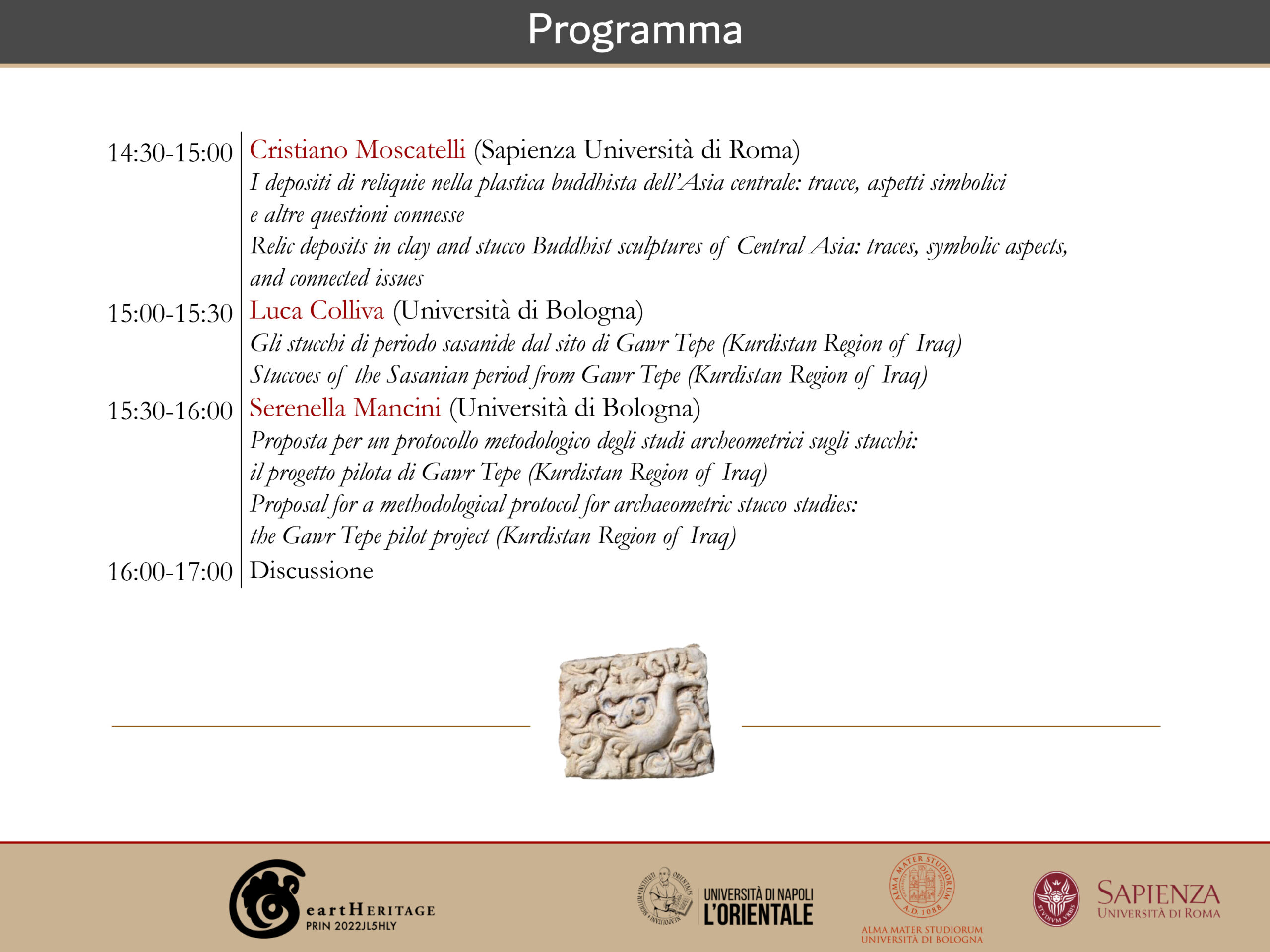
Cristiano Moscatelli (Sapienza Università di Roma)
I depositi di reliquie nella plastica buddhista dell’Asia centrale: tracce, aspetti simbolici e altre questioni connesse
Nei rituali buddhisti di consacrazione delle immagini di culto, la deposizione al loro interno di reliquie, manoscritti e altri oggetti votivi costituisce ancora oggi una pratica fondante. L’uso appare rintracciabile già nel Nord-Ovest dell’India nei primi secoli dell’Era Comune, da cui si diffonde in tutta l’Asia buddhista mantenendo immutati certi caratteri distintivi. In questo vastissimo contesto, l’evidenza associata alle produzioni scultoree in argilla e stucco dei siti dell’Asia centrale (III/IV-VIII secolo e.V.) è ancora poco nota. Si tratta invero di tracce assai scarse e frammentarie, che sono state mal documentate dagli scavi archeologici o che ancora attendono uno studio sistematico. Ciononostante, esse rappresentano una fonte preziosa per l’indagine di tutti quei processi – materiali, rituali e simbolici – che regolavano e definivano la creazione delle immagini di culto. Il contributo offre un quadro di tali evidenze, analizzandole all’interno di un articolato corpus di testimonianze archeologiche e storico-artistiche sulla pratica afferenti a contesti culturali e cronologici variegati.
Relic deposits in clay and stucco Buddhist sculptures of Central Asia: traces, symbolic aspects, and connected issues
Placing relics, texts, and other votive objects within statues is a foundational act in the Buddhist consecration of cult images. Likely traceable in Northwestern India during the first centuries of the Common Era, the practice gradually spread across Buddhist Asia while retaining certain distinctive features. Within this broad context, the evidence associated with clay and stucco sculptural productions from Central Asian sites (3rd/4th-8th century CE) is still little known. These are, in fact, scarce and fragmented traces, having been poorly documented by archaeological excavations or left awaiting systematic study. Nonetheless, they represent a valuable source for investigating the material, ritual, and symbolic processes that regulated and defined the creation of sculptures. This contribution offers an overview of such evidence and considers it within a large corpus of archaeological and art-historical materials on the Buddhist consecration of sculptures across different cultural and chronological contexts.
Luca Colliva (Università di Bologna)
Gli stucchi di periodo sasanide dal sito di Gawr Tepe (Kurdistan Region of Iraq)
L’intervento presenta gli stucchi di periodo sasanide rinvenuti nel sito di Gawr Tepe (KRI, Iraq) durante gli scavi condotti dalla Missione Storico-Archeologica Italiana in Kurdistan (MiSAK). L’analisi comparativa del materiale inedito ritrovato durante le campagne del 2023 e del 2024 prende in esame le tecniche di produzione e le influenze artistiche, con particolare attenzione ai motivi decorativi e alla funzionalità degli elementi architettonici. L’analisi stilistica degli stucchi, accompagnata da un confronto con altre produzioni coeve, permette di delineare le interazioni culturali dell’epoca nel territorio.
Lo studio esplora anche il contesto storico e sociale del sito di Gawr Tepe, contribuendo a una più ampia comprensione del paesaggio archeologico della regione. I risultati evidenziano l’importanza degli stucchi come testimoni significativi delle dinamiche artistiche e culturali nel periodo tardoantico.
Stuccoes of the Sasanian period from Gawr Tepe (Kurdistan Region of Iraq)
The paper presents the Sasanian period stuccoes found at the site of Gawr Tepe (KRI, Iraq) during excavations conducted by the Italian Historical-Archaeological Mission in Kurdistan (MiSAK). The comparative analysis of the unpublished material found during the 2023 and 2024 campaigns examines production techniques and artistic, contributing to a broader understanding of the region’s archaeological landscape. The results highlight the importance of the stuccoes as significant witnesses to artistic and cultural dynamics in the Late Antique period.
Serenella Mancini (Università di Bologna)
Proposta per un protocollo metodologico degli studi archeometrici sugli stucchi: il progetto pilota di Gawr Tepe (Kurdistan Region of Iraq)
Questo studio presenta una proposta per l’elaborazione di un protocollo metodologico dedicato agli studi archeometrici sugli stucchi, basata sull’analisi dei materiali provenienti dallo scavo della MiSAK, la Missione Storico-Archeologica Italiana in Kurdistan, presso il sito archeologico di Gawr Tepe (KRI, Iraq). L’intervento si focalizza sull’integrazione di tecniche analitiche al fine di caratterizzare composizione, provenienza e proprietà tecnologiche dei materiali in stucco rinvenuti. Il progetto mira a stabilire linee guida per future ricerche archeometriche e i risultati preliminari del progetto pilota evidenziano l’importanza di un approccio sistematico e standardizzato nella ricerca.
Proposal for a methodological protocol for archaeometric stucco studies: the Gawr Tepe pilot project (Kurdistan Region of Iraq)
This study presents a proposal for the elaboration of a methodological protocol dedicated to archaeometric studies on stuccoes, based on the analysis of materials from the excavation of MiSAK, the Italian Historical-Archaeological Mission in Kurdistan, at the archaeological site of Gawr Tepe (KRI, Iraq). The project focuses on the integration of analytical techniques in order to characterise the composition, provenance and technological properties of the stucco materials found. The project aims to establish guidelines for future archaeometric research, and the preliminary results of the pilot project highlight the importance of a systematic and standardised approach in research.