
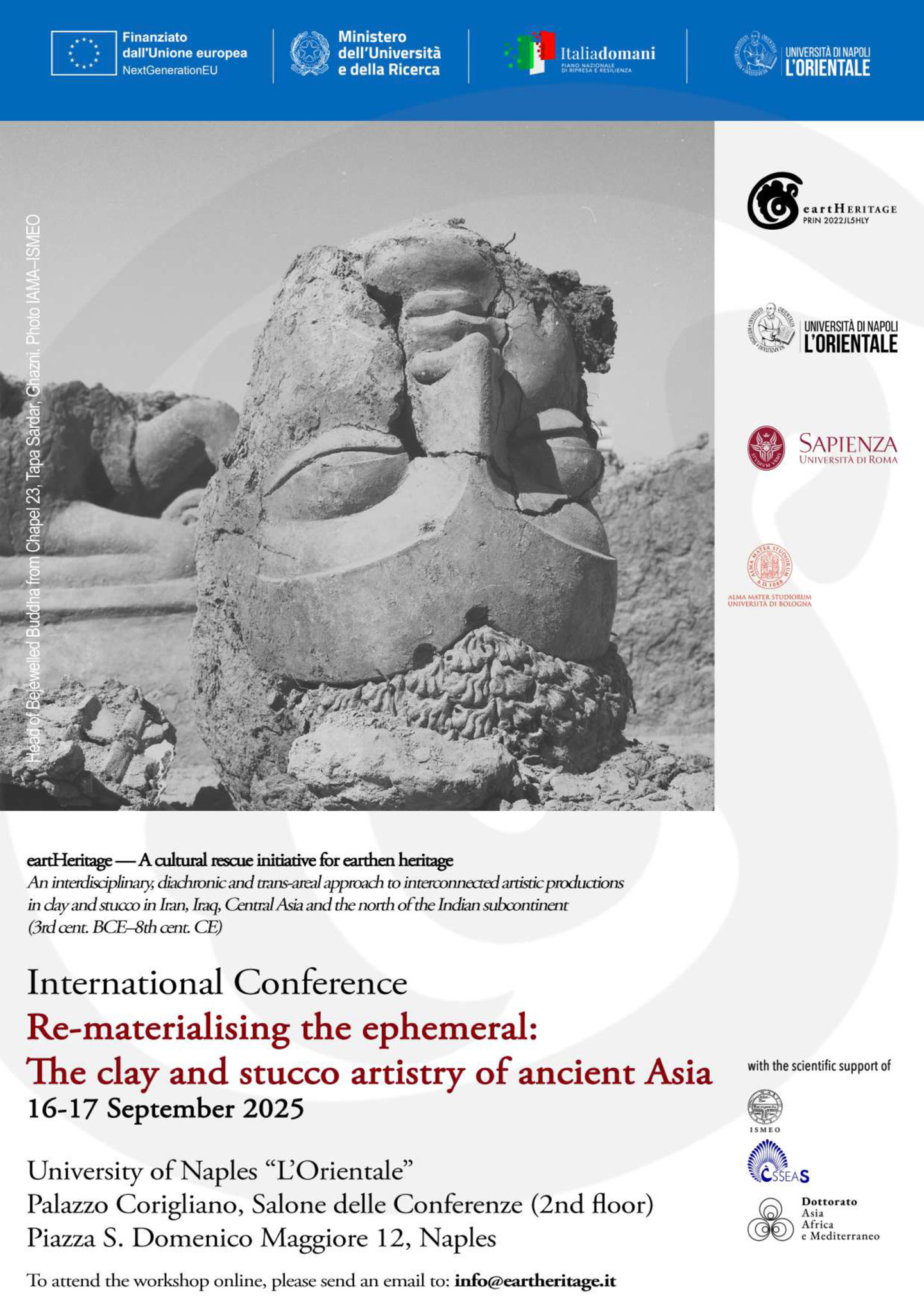
We are pleased to announce the International Conference
Re-materialising the ephemeral: The clay and stucco artistry of ancient Asia
organised within the framework of the PRIN project eartHeritage – A cultural rescue initiative for earthen heritage: An interdisciplinary, diachronic and trans-areal approach to interconnected artistic productions in clay and stucco in Iran, Iraq, Central Asia and the north of the Indian subcontinent (3rd cent. BCE-8th century CE)
16th-17th September 2025
University of Naples “L’Orientale”, Palazzo Corigliano, Salone delle Conferenze (2nd floor), Piazza S. Domenico Maggiore 12 – 80134, Naples
Thanks to the contributions of scholars from different areas of specialisation, the workshop will highlight a wealth of meanings, technical and material knowledge, local and trans-regional aspects of a formidable tradition, which remains only vaguely known, and too often underestimated, due to the poor preservation of its physical remains.
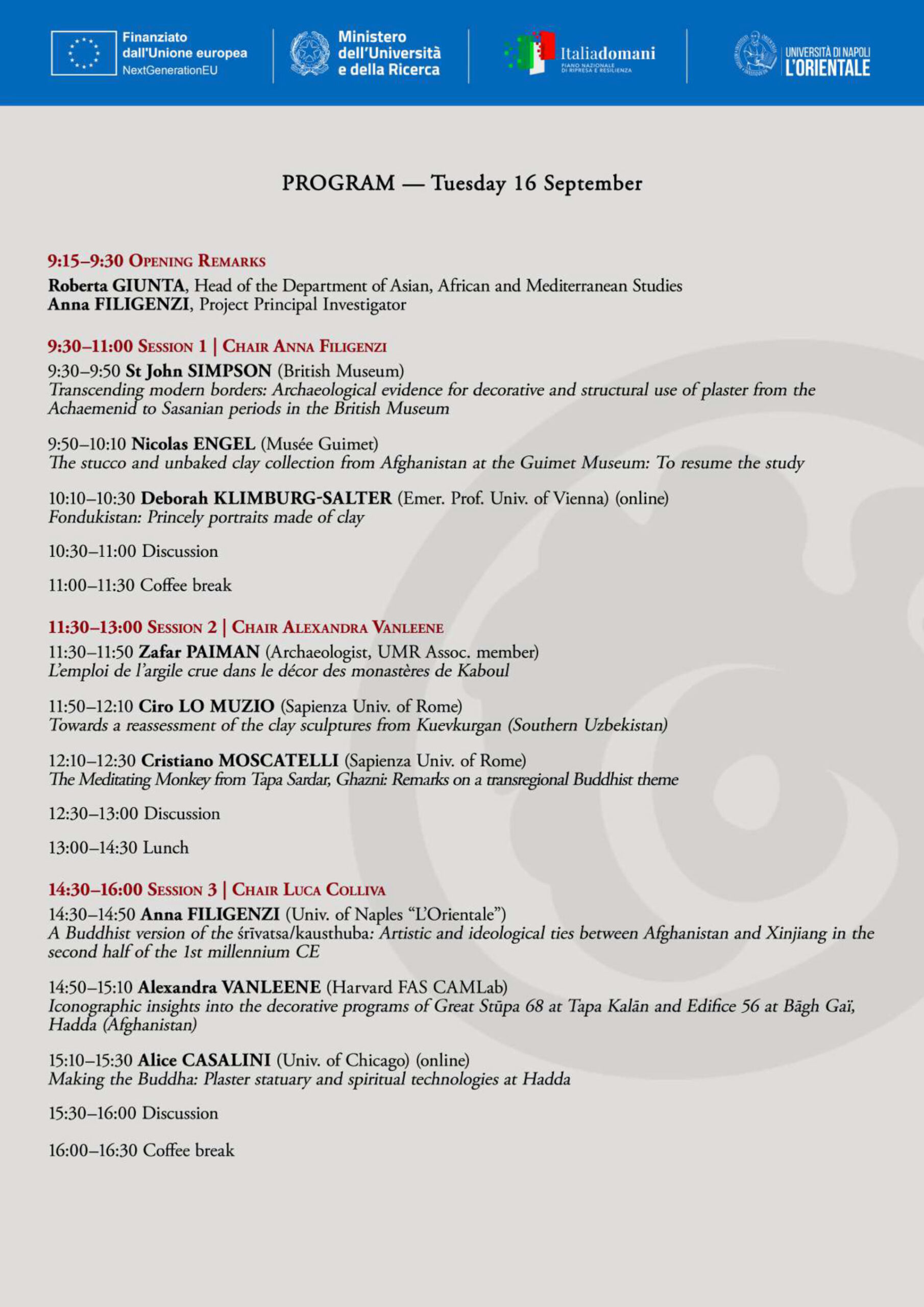
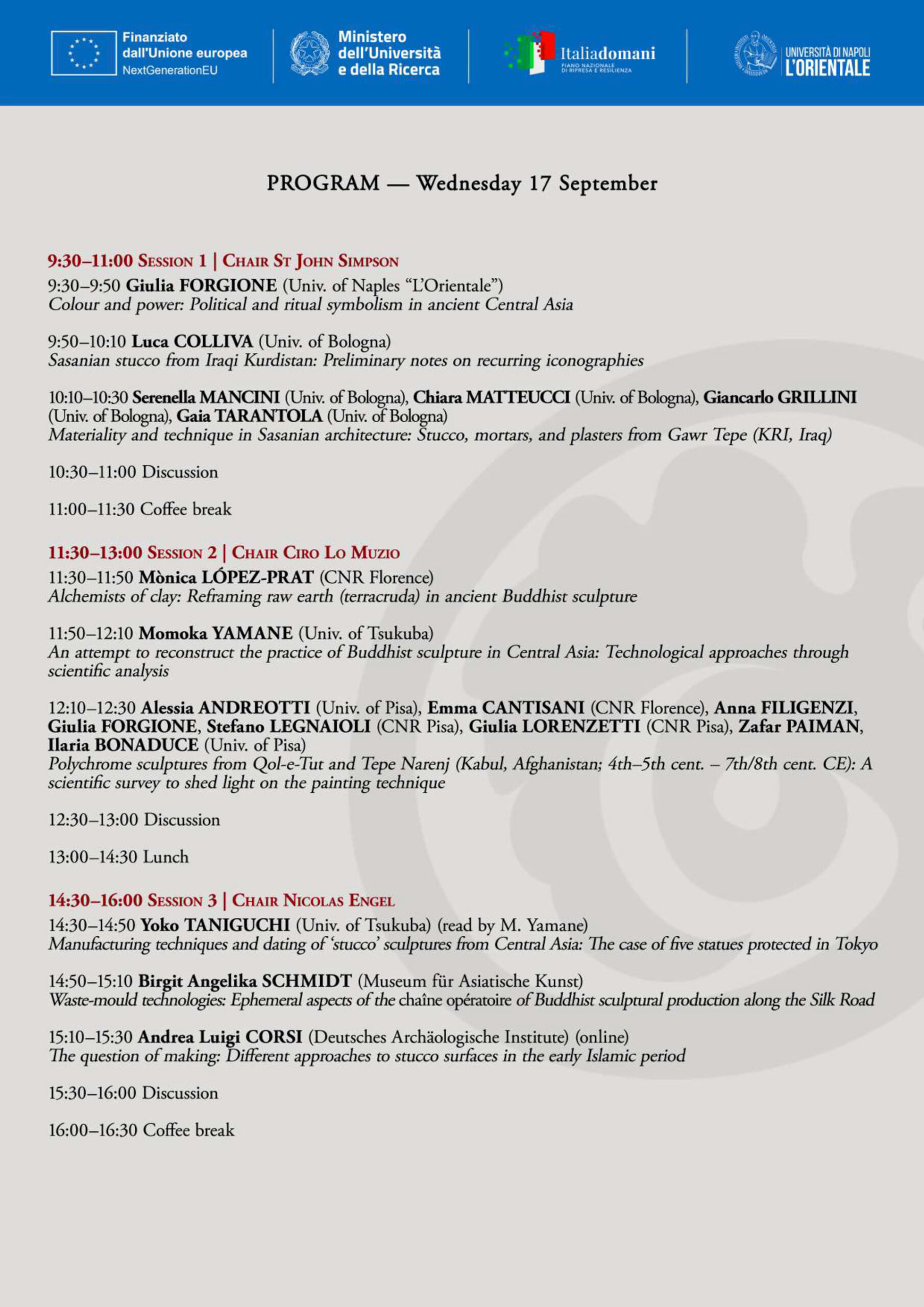
Abstracts
Alessia ANDREOTTI (Univ. of Pisa), Emma CANTISANI (CNR Florence), Anna FILIGENZI (Univ. of Naples “L’Orientale”), Giulia FORGIONE (Univ. of Naples “L’Orientale”), Stefano LEGNAIOLI (CNR Pisa), Giulia LORENZETTI (CNR Pisa), Zafar PAIMAN (Archaeologist, UMR Assoc. Member), Ilaria BONADUCE (Univ. of Pisa)
Polychrome sculptures from Qol-e-Tut and Tepe Narenj (Kabul, Afghanistan; 4th-5th cent. – 7th/8th cent. CE): A scientific survey to shed light on the painting technique
The sites from which the samples came are Qol-e-Tut and Tepe Narenj, both in the Kabul area, near Lake Hashmat Khan, a few hundred meters away from each other. A detailed understanding of the organic and inorganic chemical composition is crucial for identifying not only the original materials used by the artisan/artist but also for enabling the detection of degraded materials induced by time, human reuse, pollution and so on. Both sites can be dated to the period from approximately the 4th-5th century to the 7th/8th century, based on archaeological, numismatic and ceramic data. Different clay-based sculptures covered with white “stucco” have been sampled. Currently different organic and inorganic materials in terracruda sculptures from the same Afghan sites have been characterized by different authors, but the chemical analysis of these materials at trace levels poses challenges to scientists due to their complex compositions, susceptibility to degradation processes. Therefore, we have not yet reached a complete understanding of their manufacturing technique. Analytical techniques based on chromatography and mass spectrometry, Py-GC-MS (pyrolysis gas chromatography-mass spectrometry), GC-MS play a crucial role in characterizing organic binders. This paper focuses on these current analytical procedures that allow the characterization of macromolecules which are transformed because of ageing. Moreover, the mineralogical component and stratigraphy have been investigated by means of X-ray diffraction analysis and cross-section and thin sections optical microscopy observations. Finally, scanning electron microscopy (SEM) with energy-dispersive X-ray spectroscopy (EDS) and Raman spectroscopy were performed to study the surface morphology and elemental composition and typology of residue pigments.
Alice CASALINI (Univ. of Chicago)
Making the Buddha: Plaster statuary and spiritual technologies at Hadda
The question animating this paper is borne out of two main considerations regarding the study of Gandhāran Buddhism and its material/visual culture: on the one hand, the fragmentary nature of the corpus at large and the records around it prevent many reconstruction attempts of monuments and their décor; on the other hand, since the material turn in art history in the late 1990s/early 2000s, studies on materiality in South and Central Asia have increasingly focused on technical issues to the demerit of visual studies. Bringing together these two considerations, the focus of the paper rests solely within a large but finite corpus of plaster sculptures from the monasteries of Hadda, in the Jalalabad province of Afghanistan, and on their Buddhist context. The paper looks at a variety of technical issues in the building, sculpting, and modelling of various figures of the Buddha and highlights the entanglements of manufacture and spiritual practice. Ultimately the paper suggests that, in some cases, artistic processes might be mapped onto certain types of spiritual enhancement fostered during meditation practices and centered around ideas of bodily care and refinement.
Luca COLLIVA – MiSAK, Univ. of Bologna
Sasanian Stucco from Iraqi Kurdistan: Preliminary Notes on Recurring Iconographies
The discovery of newly documented stucco fragments at the sites of Gawr Tepe and Hawsh Kuri, in the Garmian area of the Kurdistan Region of Iraq (KRI), has opened significant new perspectives for the study of Sasanian decorative programmes. Stucco has long been recognised as a key feature of monumental architecture in the Sasanian period, yet much of the surviving evidence is fragmentary, dispersed, and poorly contextualised. The material now under investigation by the Italian Historical and Archaeological Mission in Kurdistan (MiSAK) represents, despite the early stage of research, a new systematic corpus for this region. These discoveries provide a crucial opportunity to reassess iconographies, techniques, and symbolic functions of Sasanian and early Islamic stucco within a frontier zone that served as a cultural and commercial crossroads between Mesopotamia and the Iranian plateau.
So far, the assemblages from Gawr Tepe and Hawsh Kuri mainly comprise vegetal and geometric motifs that closely align with well-documented Sasanian repertoires. Recurring iconographies suggest a decorative programme once adorning the monumental palace identified at Gawr Tepe A. Among the most notable are beaded frames, phytomorphic ornaments, and curvilinear elements that may allude to grape clusters. Although fragmentary, these motifs highlight both the continuity of visual codes across the empire and the potential for local adaptation. Comparisons with decorative traditions from several Sasanian and early Islamic period sites, including Kish, Ctesiphon, Barz Qawaleh, JilJilak, as well as Sir Bani Yas and al-Qusur, indicate that the fragments from Gawr Tepe and Hawsh Kuri were part of the broader artistic koine of the late Sasanian world, while also reflecting specific regional preferences in composition and style.
The new evidence from Iraqi Kurdistan highlights the region as a key centre for the study of Sasanian and early Islamic decorative traditions. The recurring motifs identified at Gawr Tepe and Hawsh Kuri shed light on the circulation, adaptation, and reinterpretation of visual codes across the late antique Middle East. They also demonstrate the necessity of integrating iconographic, technological, and contextual analyses in order to recover the complexity of a fragile yet central component of Sasanian monumental culture.
Andrea Luigi CORSI (Deutsches Archäologische Institut)
The Question of Making: Different Approaches to Stucco Surfaces in the Early Islamic Period
The early Islamic period witnessed a significant increase in the use of decorative stucco in architecture, along with its introduction into regions traditionally accustomed with other building materials. This rise in production was accompanied by, and in a sense directly proportional to, a growth in technical and manufacturing solutions. This was likely stimulated by the increased mobility of artisans, who were requested to meet the intense building projects of the 8th and 9th centuries in particular.
This presentation aims to illustrate various technical solutions, moving beyond the traditional dichotomy between carved and moulded stuccowork. Stuccoes from a wide geographical area will be considered, including the Syrian region (Khirbat al-Mafjar and Raqqa), Iraq (Ctesiphon and al-Hira), and Iran (Siraf and Isfahan), to display divergences and convergences, as well as possible local developments and external influences. It will focus on artisanal marks and will include preliminary considerations about tools employed to achieve specific results. In this regard, hypotheses will be put forward on possible external technical contaminations, i.e. the technological encounters and exchanges between artisans specialised in working with different materials, particularly wood and stone.
Nicolas ENGEL (Musée Guimet)
The stucco and unbaked clay collection from Afghanistan at the Guimet Museum: to resume the study
The Afghan collection of the Musée Guimet is composed mainly of stuccoes and raw clay from excavations carried out by the French archaeological delegation in Afghanistan in the years 1920-1940 at the sites of Hadda, Bamiyan and Fonduqistan. These works testify to the virtuosity of the craftsmen but also to the longevity of this artistic production and an evolution of techniques and taste, from the 3rd to the 8th century. The observation of specific unbaked clay sculptures during the visit of foreign researchers allows us to resume the study of this corpus in the light of the knowledge provided by recent works on similar corpora.
Anna FILIGENZI (Univ. of Naples “L’Orientale”)
A Buddhist version of the śrīvatsa/kaustubha: Artistic and ideological ties between Afghanistan and Xinjiang in the second half of the 1st millennium CE
During the second half of the 1st millennium CE, and probably driven by growing competition with Brahmanic cults, the body of Buddha in the visual arts was enriched with a new lakṣaṇa: a decorative element on the chest, which can take various forms, but which undoubtedly suggests a homology with the body of Viṣṇu and precisely with the śrīvatsa and/or kaustubha, auspicious signs that refer to Viṣṇu’s power to heal and grant wishes.
The introduction of this element into the iconography of Buddha does not seem to be universally widespread. To date, it has been found in some sites in Afghanistan and Xinjiang, in works dating roughly between the 7th and 9th centuries CE. Furthermore, as evidenced by cases in which the figure of the Buddha with a decoration on his chest appears in association with others without it, the attribution of this lakṣaṇa is not indiscriminate, but clearly linked to specific circumstances in which the quality expressed by it becomes manifest.
This contribution will propose interpretative hypotheses about the meaning of the decoration on the Buddha’s chest, analysed against the background of the contexts in which it appears. At the same time, it will propose a methodological reflection on the challenges posed by the inherent fragility and fragmentary preservation of the cultural heritage of the regions concerned, and on the need to reconstruct its original forms through cross-comparisons between sculpture and painting, between regional variants and common features, while also attempting to identify key meanings that characterise not only individual images, but the whole to which they originally belonged.
Giulia FORGIONE (Univ. of Naples “L’Orientale”)
Colour and Power: Political and Ritual Symbolism in ancient Central Asia
This contribution provides a preliminary investigation into the visual strategies employed by the ruling elite in Central Asia, approximately from the 1st to the 8th century CE. Despite the fragmentary nature of the archaeological record—exacerbated by the use of perishable materials and a scarcity of scientific excavations—this study aims to explore how aristocratic figures were visually constructed to convey power, legitimacy and identity.
The starting point for our inquiry will be the well-known and much debated frieze from Khalchayan (southern Uzbekistan). Variously dated from the Yuezhi period to as late as the early or middle Kushan period (1st cent BCE-mid-2nd cent. CE), the frieze has been subject to different interpretations, which nonetheless agree on its dynastic commemorative character. A close examination of stylistic and chromatic features, especially skin tone, reveals a symbolic use of polychromy as a narrative tool rather than a naturalistic choice. Through visual comparison with sculptures and wall paintings from other sites, among which Dalverzin Tepe, Ajina Tepa, Dilberjin, Tapa Sardar, Tepe Narenj, this article tentatively explores, in a diachronic perspective, the differentiation between secular dynastic imagery (of political legitimation) and images of spiritual authority as well as between masculinity and femininity. Although limitations in the material record and chronological data prevent definitive conclusions, the study underscores the importance of colour, iconographic codes, and spatial context in the articulation of aristocratic self-representation in Central Asia through most of the 1st millennium CE.
Deborah KLIMBURG-SALTER (Emer. Prof. Univ. of Vienna)
Fondukistan: Princely portraits made of clay
Abstract not available
Ciro LO MUZIO (Sapienza – Univ. of Rome)
Towards a Reassessment of the Clay Sculptures from Kuevkurgan (Southern Uzbekistan)
This paper re-examines a series of clay sculptural fragments unearthed at Kuevkurgan, a rural residence in northern Tokharestan (present-day southern Uzbekistan), estimated to date from the mid-5th to mid-6th centuries.
Following a description of the fragments and the archaeological context in which they were discovered, the paper re-examines previous interpretations of the sculptures and their architectural setting. While stylistic similarities with Gandharan Buddhist art were acknowledged, the idea that these sculptures belonged to a Buddhist context was firmly rejected in favour of interpretations linking them to the celebration of local political authority or dynastic ancestors.
This study aims to re-evaluate these fragments by comparing them more closely with Buddhist clay sculptures from neighbouring regions, particularly those relating to, or influenced by, the late Gandharan or post-Gandharan tradition. The iconography, style and technical execution highlight significant similarities with unbaked clay sculptures from Tapa Sardar and other monastic centres to the south of the Hindu Kush, as well as from northern Tokharestan (Ajina Tepe). These similarities suggest that the Kuevkurgan sculptures should be considered part of the Buddhist artistic tradition and that they may date from a slightly later period than previously thought.
Mònica LÓPEZ-PRAT (CNR Florence)
Alchemists of Clay: Reframing Raw Earth (terracruda) in Ancient Buddhist Sculpture
Raw earth or unfired clay (terracruda, as opposed to terracotta) is often perceived in art historical discourse as a fragile and impermanent medium, suitable only for ephemeral works or preparatory models. However, textual, material, and ethnographic evidence suggests that, in some Buddhist contexts, terracruda was used with the clear intention of creating monumental sculptures intended to last and be venerated for centuries.
This contribution explores how Sanskrit treatises on image-making, comparative analysis of archaeological sculpture, and surviving traditional practices point to a sophisticated technological system in which artists acted as true “alchemists of clay”, mastering the transformation of raw earth into durable and refined sculptural forms. Through the careful selection of soils, detailed knowledge of how to mix specific organic additives, and controlled processes of modelling and drying, sculptors developed methods capable of producing large-scale and durable works in stable conditions.
Viewed through the lens of materials science and supported by living traditions and textual interpretation, this study challenges the assumption of clay’s ephemerality and aims to demonstrate that terracruda has been deliberately chosen in certain Buddhist contexts as a technically valid and refined material used to give lasting, monumental form to the sacred.
Serenella MANCINI (Univ. of Bologna), Chiara MATTEUCCI (Univ. of Bologna), Giancarlo GRILLINI (Univ. of Bologna), Gaia TARANTOLA (Univ. of Bologna)
Materiality and Technique in Sasanian Architecture: Stucco, Mortars, and Plasters from Gawr Tepe (KRI, Iraq)
Since 2023, the Italian Historical and Archaeological Mission in Kurdistan (MiSAK), in collaboration with the Department of Cultural Heritage of the University of Bologna and the Directorate of Antiquities and Heritage of Garmian, has been conducting research at the archaeological site of Gawr Tepe (KRI, Iraq). The settlement, inhabited from at least the Sasanian period until the 13th century CE, is distinguished by a monumental stucco-decorated palace, whose plasters and mortars show close correspondences with the composition of the stuccoes themselves.
In cooperation with the Conservation Science Laboratory of the University of Bologna, a comparative and diachronic study of gypsum-based materials (mortars, plasters, and stuccoes) has been initiated. The research combines different analytical techniques, including X-ray diffraction and granulometric analysis of aggregates, to investigate composition, production technologies, raw material selection, and alteration processes. This protocol, designed to yield comparable datasets, aims to reconstruct technological traditions, trace potential regional production networks, and document diachronic changes in gypsum-based construction and decorative techniques. Beyond enhancing our understanding of Sasanian and early Islamic material culture, this research also provides a methodological framework for future investigations and conservation interventions across the region.
Cristiano MOSCATELLI (Sapienza – Univ. of Rome)
The Meditating Monkey from Tapa Sardar, Ghazni: Remarks on a transregional Buddhist theme
Among the clay sculptures excavated at the Buddhist site of Tapa Sardar (Ghazni, Afghanistan) by the Italian Archaeological Mission, two meditating monkeys are particularly noteworthy. These monkeys belonged, respectively, to the decorative programs of Chapels 23 and 37 (Main Stūpa terrace), both centred on an epiphanic image of the Buddha and datable to around the 7th-8th century CE.
Meditating monkeys first appear in Gandharan stone sculpture, particularly in scenes illustrating the visit of Indra to the Buddha meditating in a cave. Later, they recur not only at Tapa Sardar and other Buddhist centres in Central Asia, but also in the painted decorations of the Kucha caves (Xinjiang), showing a wide diffusion and persistence of this motif across Buddhist regions from roughly the mid- to late 1st millennium CE.
Following an overview of these figurative contexts, with special focus on Tapa Sardar, this contribution examines the motif of the meditating monkey in light of Buddhist textual traditions. Texts of diverse nature depict this animal as a metaphor for the human mind, prone to corruption and desire, yet capable of discipline, renewal, and spiritual growth. As such, the monkey embodies a doctrinal narrative of the human path toward enlightenment.
Zafar PAIMAN (Archaeologist, UMR Assoc. Member)
L’emploi de l’argile crue dans le décor des monastères de Kaboul
De nombreuses sculptures, parfois monumentales, réalisées soit entièrement en argile rouge ou bien dans une argile jaune recouverte d’argile rouge ou même d’argile verte, selon une mise en œuvre délicate, proviennent de divers monastères bouddhiques de Kaboul ( Tepe Khazâna, Tepe Maranjân 1, Khwâja Safâ, Tepe Nârenj, Qol-e-Tut) et sa région (Bâzikhel), du Logar (Mes-e-Ainak, Kharwâr), du Wardak (Al Ghatâ), ainsi que de Ghazni (Tepe Sardâr), Bamiyan (Kâmard), Fondukistan, et Hadda (Tepe Kafariya, Tepe Shotor). Elles témoignent de la place majeure que tient ce matériau dans l’art bouddhique de la partie sud de l’Afghanistan. Nous avons d’ailleurs connaissance de mines d’argile rouge et verte dans Kaboul et sa proche région.
La découverte des restes de telles sculptures en argile crue de couleur rouge– à l’exclusion de toute œuvre en pierre-, combinée à celles de monnaies et de céramiques, effectuées sur les sites de Khwâja Safâ, Tepe Nârenj et Qol-e-Tut, fouillés sous notre direction entre 2004 et 2018, leur comparaison avec les sculptures des monastères mentionnés ci-dessus, nous permettent d’affirmer qu’elles appartiennent toutes à une phase très tardive du bouddhisme du sud de l’Afghanistan, qui n’est pas antérieure à la fin du 7e ou au début du 8e siècle. Ceci a été confirmé par l’analyse de cette argile réalisée par un laboratoire italien (cf Giulia Forgione, 1/2019. Clays and Colours: Tracking technologies and theories of vision in the ancient Buddhist art of Afghanistan, pp. 130-141) et remet donc en cause l’opinion la plus généralement acceptée, attribuant les œuvres utilisant l’argile rouge à des périodes plus anciennes.
Nos recherches à Tepe Narenj et Qol-e-Tut indiquent, par ailleurs, que ces monastères sont demeurés en activité jusqu’au milieu du 11è siècle.
Birgit Angelika SCHMIDT (Museum für Asiatische Kunst)
Waste-Mould Technologies: Ephemeral Aspects of the Chaîne Opératoire of Buddhist Sculptural Production along the Silk Road
This study reconstructs the sophisticated artisanal techniques and material knowledge underlying the modular production of Buddhist clay sculptures along the ancient Northern Silk Road (3rd-14th centuries CE), with particular emphasis on moulding and modelling processes in gypsum and clay. Based on systematic investigation of original gypsum negative moulds from the Berlin ´Turfan Collection´ and corresponding clay casts in collections worldwide, it examines key aspects of the chaîne opératoire of this widespread Central Asian practice.
Employing X-ray diffraction analysis, morphological examination, and technical reconstruction, this research demonstrates how Buddhist craftsmen employed waste-mould processes in which sacrificed clay prototypes – ephemeral working models – generated durable gypsum negatives. These clay figurines were deliberately conceived and sacrificed as transient components, enabling serial and modular reproduction of sculptural elements and supporting the long-term continuity of specific iconographic forms, apparently transmitted unchanged across several centuries.
The study focuses particularly on workshops in Karashahr (Yanqi, present-day Xinjiang), where more than thirty moulds were discovered and subsequently transported to Berlin in the early 20th century. These artefacts constitute the world’s largest collection of moulds from a single Silk Road site.
The process embodies a remarkable material strategy whereby calculated transience created sustained reproductive potential. Through detailed examination of the negative moulds and experimental reconstruction of the casting procedure, this research demonstrates how technical analysis of original tools can illuminate past artisanal knowledge. The findings enhance our understanding of how technical innovation in gypsum and clay working facilitated the preservation and transregional transmission of Buddhist iconography within Central Asian monastic networks.
St John SIMPSON (British Museum)
Transcending modern borders: archaeological evidence for decorative and structural uses of plaster from the Achaemenid to Sasanian periods in the British Museum
The British Museum has an important collection of decorative stuccoes and architectural plaster samples from Iran and Iraq. The largest proportion are from excavations at the Islamic sites of Samarra and Siraf, but these lie outside the remit of this paper and have recently started to receive study and publication in their own right. This paper instead offers an up-to-date review of the collection dating from the Achaemenid to post-Sasanian periods, some published but others not. The best-known of these are display-quality decorative wall elements, notably from Loftus’ excavations at the so-called ‘Parthian house’ at Uruk/Warka (1854), the Deutsches Orient-Gesellschaft excavations of elite residences on the southern outskirts of the Sasanian capital of Ctesiphon (1928/29, 1930/31), and purchased pieces from the post-Sasanian residence at Chal Tarkhan in northern Iran. However, the collection also includes a painted ‘doll’ excavated by Major Daly in the so-called ‘Middle Tylos period’ (i.e. Parthian period) cemetery at Janussan on Bahrain in the early 1920s, and small fragments of painted wall plaster, decorative floor plaster and undecorated architectural fragments from various other sites, including Persepolis and more recent excavations by the author at Merv. This paper offers the opportunity to present this group as a whole and highlight research in progress.
Yoko TANIGUCHI (Univ. of Tsukuba)
Manufacturing techniques and datings of ‘stucco’ sculptures from Central Asia: In the case of 5 statues protected in Tokyo
In 2015, we had protected 4 Buddha sculpture heads at the auction in Tokyo from Central Asia. Most of the heads were brought to Japan during USSR invasion to Afghanistan, before the first Taliban regime. They are not recent looted objects from the records. We initially planned to send them back to the National Museum of Afghanistan. Unfortunately, we had to postpone the event due to the pandemic of Covid-19 in March 2020, and the Taliban seizure of power in Afghanistan on 15 August 2021.
Therefore, we have decided to conduct diagnostic analyses on those sculptures while they are in Japan: with the X-ray CT is a Micro-focus X-ray CT, XRF, XRD, SEM-EDS, ELISA and LC-MS. 3D models were also created. Some of the heads were probably created using moding technique for the details. 2 of the heads showed positive reactions to two types of type I collagen antibodies, both bovine, cow-skin protein.
Also, radiocarbon dating technique was applied to date of manufacture. Since some sculptures did not have actual fibre.
It is the best way if we can use a plant fibre in the rendering clay as a sample. However, most of the fibres have been decomposed over the time and became inorganic which is replaced as calcium carbonate. Alternatively, we used lime-based ground, calcium carbonate, as samples. Calcium carbonate was prepared using phosphoric acid.
As an overall interpretation, inner structure and radiocarbon dating implied that the Head 2 is most suspicious as its authenticity.
We don’t conclude it certainly yet, however, we have to bear in our mind that this head could be doubtful when we plan to send them to Afghanistan. In this case, it is not a wise idea to send this Head 2 to Afghanistan.
A bluish gray, small donor sculpture, was also donated by the antique gallery in 2021.It has similar appearance as one example of a Gandharan stucco resembling schist, found at the Mehasanda site (from the late 2nd to early 3rd century) excavated by Kyoto University.
Since we have those statues in Japan, we are using these objects in small exhibitions (drawing workshops, lectures, etc.) at the numbers of locations in Japan for the public. Recently, some academic activities are developed further to young scholars in Japan who wishes to study Central Asian history and heritage. After this international colloquium in November 2024, already 2 research colloquia “Research Seminar for the Buddhist Culture along the Silkroad” were taken place in Tokyo. It is planned to organize every 4 months. 40-50 young scholars are now using this opportunity to gather together frequently. Our stucco sculptures, protected in Japan, became a starting platform for recent research network and activities.
Further studies should stand on ‘excavated’ stucco examples as a basis of technical studies. For example, recently, we are conducting further studies on Mehasanda and around the site in Pakistan from Prof. Sei’ichi. Mizuno’s excavations at the Kyoto University. We also aim to provide a comprehensive interpretation of whether the term “stucco” is appropriate from a technical and material perspective, and whether there are regional differences in techniques and materials between Bactria, Gandhara, and Xinjiang Uyghur. These research findings are expected to be the first step toward solving the previously unresolved question of the chronology of Buddhist statues in Central Asia.
Alexandra VANLEENE (Harvard FAS CAMLab)
Iconographic Insights into the Decorative Programs of Great Stūpa 68 at Tapa Kalān and Edifice 56 at Bāgh Gaï, Haḍḍa (Afghanistan)
This study examines the artistic and archaeological significance of the Haḍḍa modelling school by reconstructing two of its most important yet fragmentary decorative programs: the modeled depiction of the Assault of Māra on the western façade of Great Stūpa 68 at Tapa Kalān, and the richly ornamented but unfinished Edifice 56 at Bāgh Gaï. Drawing on archival photographs—including newly accessible images—alongside excavation reports and comparative iconographic analysis, the research underscores the complexity of Haḍḍa’s artistic language. The reexamination of Edifice 56 reveals its dedication to a ritual of donation and redemption, evidenced by the presence of Kuṣāṇa aristocratic donors and the representation of Aṅgulimāla’s conversion, both interpretable within the framework of politico-religious patronage. These findings illuminate Haḍḍa’s creative synthesis of local and foreign influences and its central role in the cultural networks of Greater Gandhāra, refining our understanding of its place in Buddhist art history and contributing to the preservation of a heritage now largely lost to destruction and dispersal.
Momoka YAMANE (Univ. of Tsukuba)
An Attempt to Reconstruct the Practice of Buddhist Sculpture in Central Asia: Technological Approaches Through Scientific Analysis
Buddhist sculpture along the Silk Road began in the Gandhara region (a cultural designation encompassing present-day northwestern Pakistan and eastern Afghanistan) around the 1st century CE in the form of stone carvings, and subsequently developed in Central Asia as sculpture modeled with plastic materials such as plaster and earth. Such sculptures were produced in association with Buddhist temple architecture, and their production is assumed to have been closely related to building materials and techniques.
A compilation and analysis of examples recorded in situ in published reports indicates that the contexts of production can be broadly categorized into “Stupa,” “Interior Architecture,” “Exterior Architecture,” and “Wall Niche,” with regional variations observed in both location and materials. From a production perspective, the presenter analyzes these sculptures and seeks to establish a systematic understanding of their regional characteristics and historical transformations within Central Asian Buddhist temples by advancing further classifications based on materials and techniques identified through scientific analyses.
To date, approximately fifty modeled sculptures from Central Asia in the collection of the Hirayama Ikuo Silk Road Museum have been analyzed using scientific methods (including portable X-ray fluorescence, X-ray diffraction, and optical microscopy), and observations of material from the Hadda site at the Musée Guimet have also been conducted. Taken together, these results indicate that, although variation exists even within the same region or site, certain characteristic production methods appear to have existed. To further clarify production variations and regional tendencies, the scientific survey will be extended to excavated objects from Northwestern Pakistan housed at Kyoto University, as well as finds from southern Uzbekistan, in order to elucidate their technical and material realities and to advance the creation of a comprehensive database.