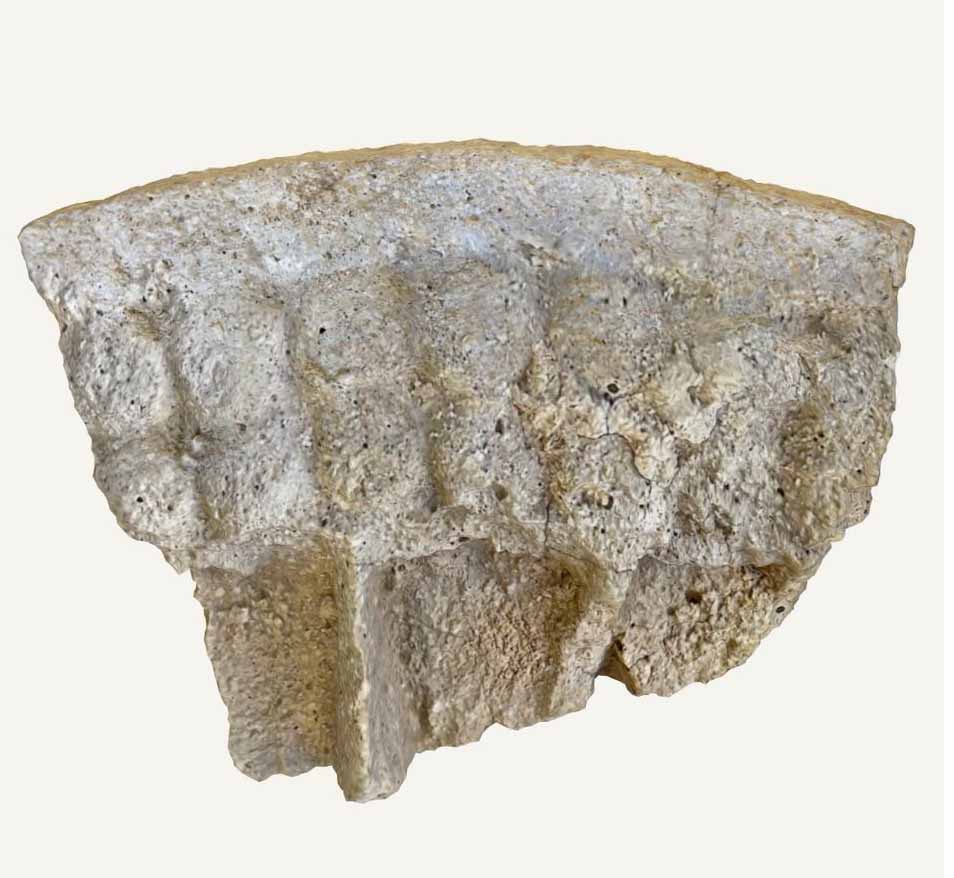
Fragments from Hawsh Kurw, recovered during field survey activities carried out by the Garmian Directorate of Antiquities and Heritage, appear to belong to a decorative composition organized around circular medallions. The preserved elements include portions of concentric borders framing radial motifs composed of single and double incised lines. These motifs are likely vegetal in character, forming stylized petals or leaves radiating from a central point, although alternative interpretations remain possible. The fragments are closely comparable to an example recovered by the MISAK expedition at Gawr Tepe, suggesting the circulation of similar decorative schemes within the region. Comparisons with related material from nearby sites further indicate that the medallions originally formed part of a larger ornamental programme. While the central area of the composition is not preserved, it may have contained a figural or symbolic image, as suggested by broadly comparable examples from other Late Sasanian and early Islamic contexts. The surviving fragments nevertheless provide valuable evidence for the use of complex geometric and vegetal designs in the architectural decoration of the Hawsh Kurw complex.