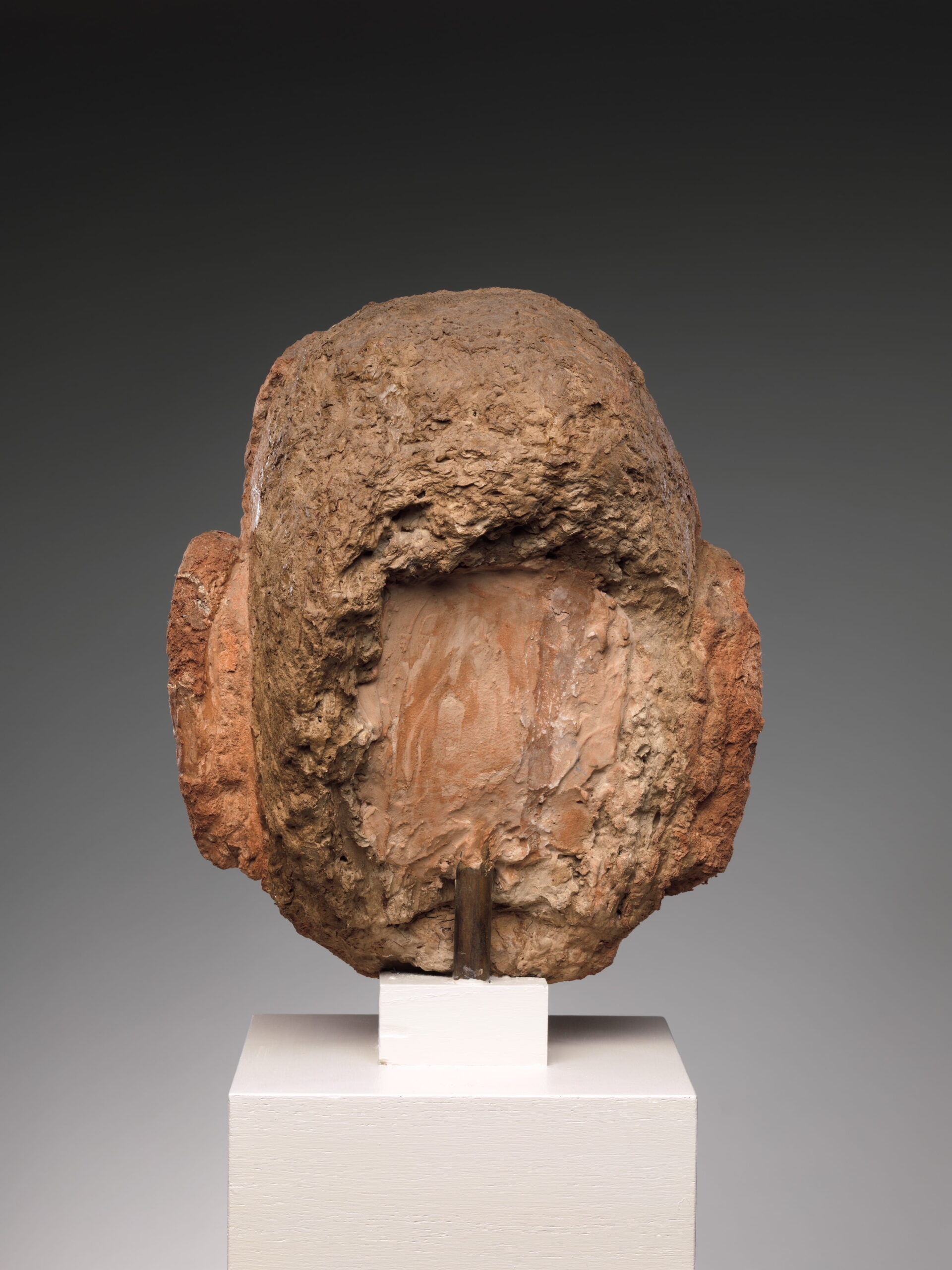
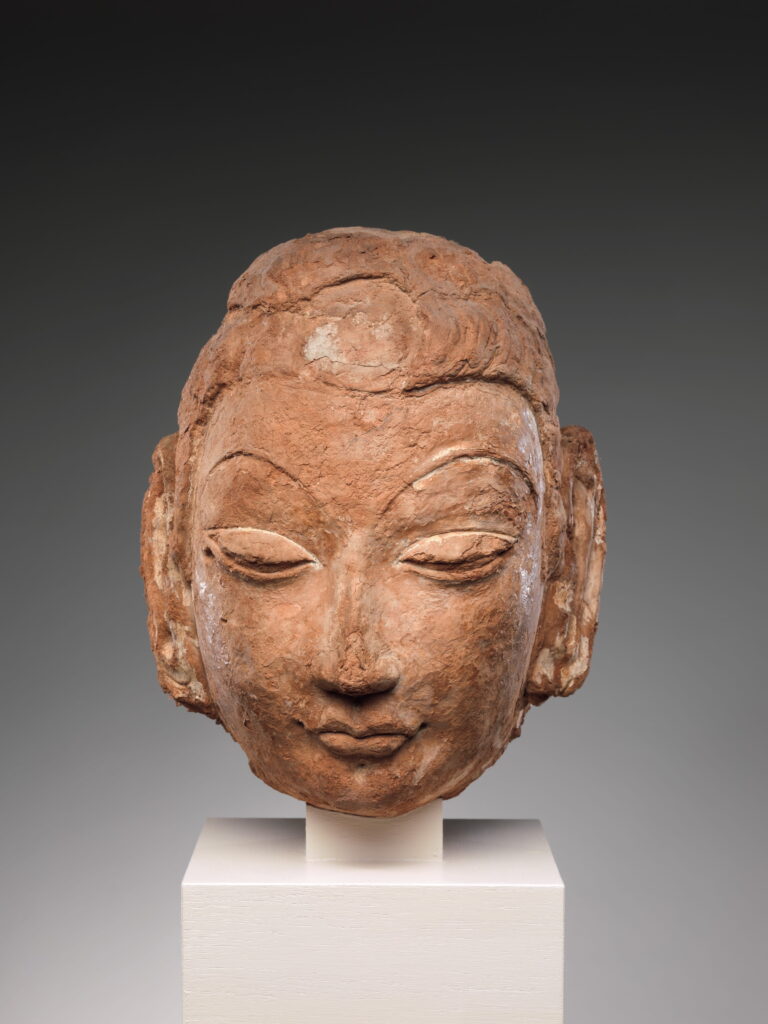
This is a head of a buddha, depicted with arched, thin eyebrows; almond-shaped, half-closed eyes; ears with elongated lobes; a slender nose; and a small mouth with full lips. The hair, preserved only in scant remnants, is arranged in vertical, wavy strands. Of particular interest is the circular trace visible at the centre of the hairline. In Indian Buddhist sculpture of the first centuries of the Common Era, the Buddha’s hair is rendered in various styles, from wavy locks to tight snail-like curls, as seen, for instance, in a meditating buddha from northwestern Pakistan in the British Museum. The latter hairstyle becomes especially widespread in Buddhist images across Asia during the second half of the 1st millennium CE (e.g., a late 5th-century CE standing buddha). In China, however, during the late Northern Wei dynasty (4th–6th century), sculptures also display a large hair whorl at the centre of the hairline and sometimes also on the ushnisha, as exemplified by a sculpture of a buddha at The Met. This feature continues to appear in the later sculptural production of the Tang dynasty period (618-907; see a seated buddha at the Sackler Museum and a buddha head at The Met). Comparisons with these later works suggest that the present head — and perhaps also the now-broken ushsnisha — originally showed a large hair whorl, providing a chronological benchmark for the sculpture as well.
The head was removed from the sculpture’s body during the excavations. The figure wears a samghati with the right shoulder exposed, and the head is surrounded by a leaf-shaped halo with rich decoration. The sculpture is flanked, on the viewer’s left, by a colossal-sized buddha and another figure of comparable iconography and scale.