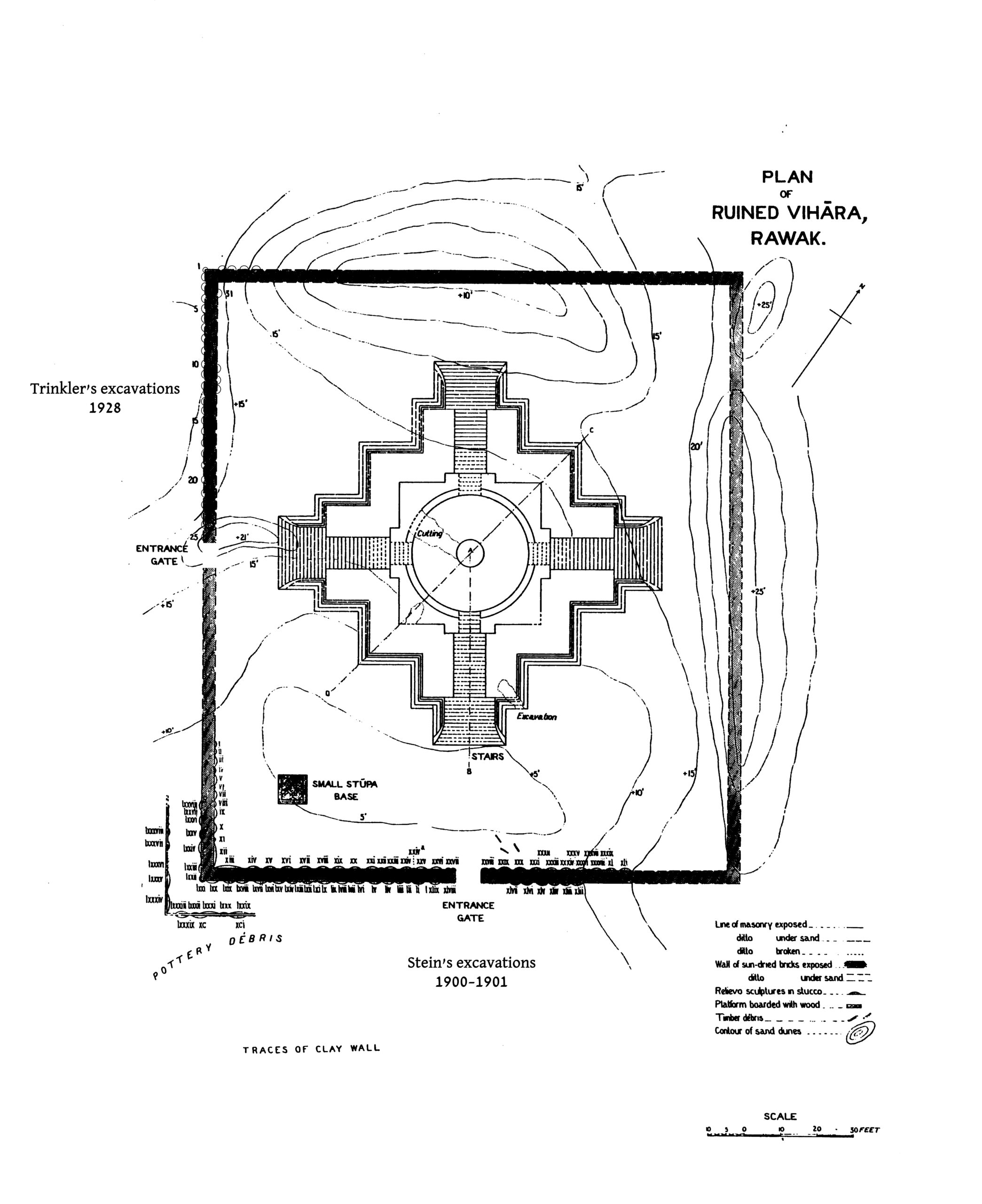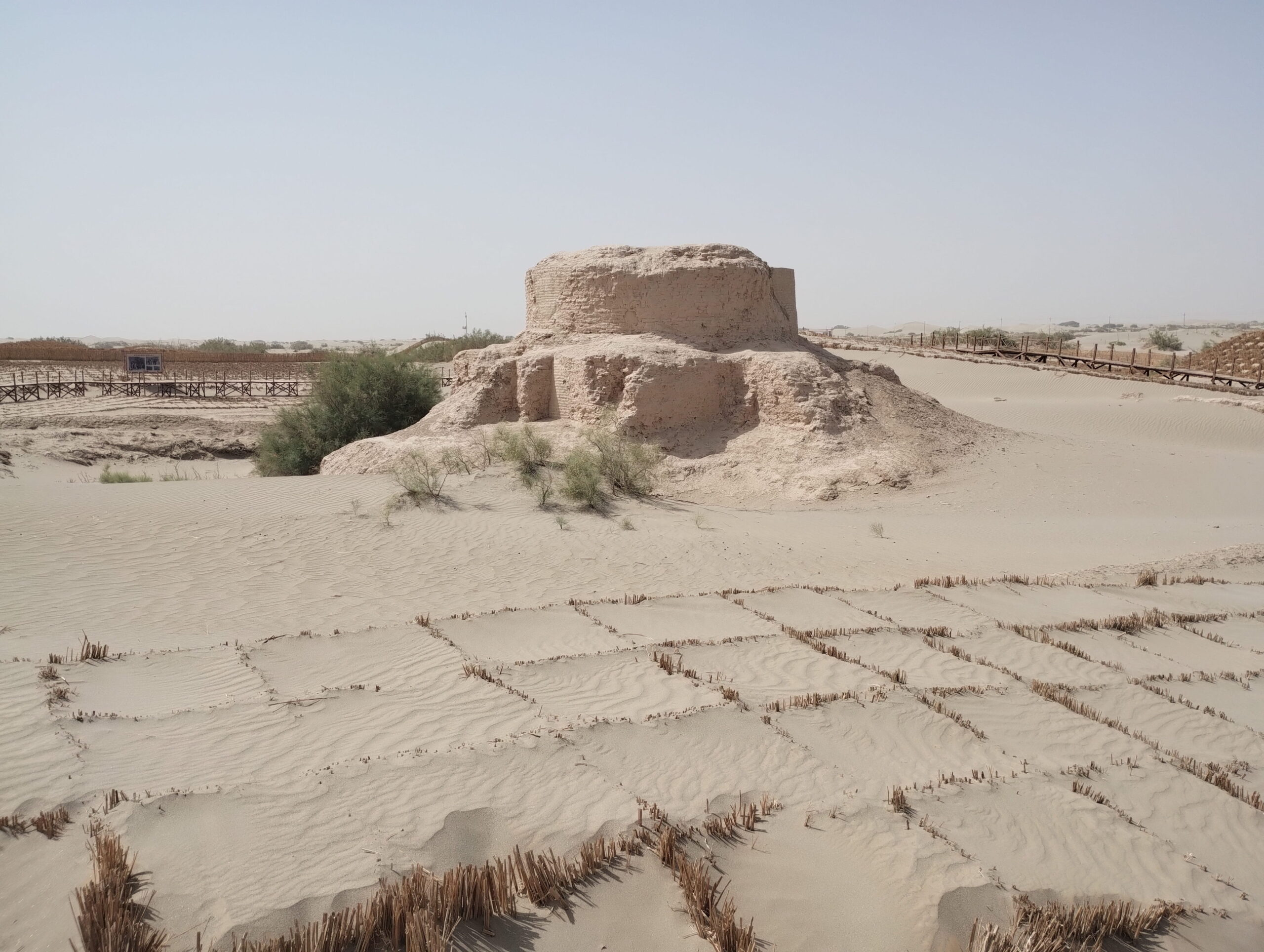
The Buddhist site of Rawak lies on the southern edge of the Tarim Basin, north of ancient Khotan, along the southern branch of the Silk Road. It consists of a large stupa featuring a square, three-tiered base (approx. 32 × 32 m), with a flight of steps at the centre of each side leading up to the (now poorly preserved) false dome. The monument rises at the centre of a nearly square sun-dried brick enclosure (50 × 43 m), only partially excavated, with its corners aligned to the cardinal points. Near the southern corner are the remains of a thinner outer enclosure. Inside and outside both enclosures, a continuous sequence of stucco wall sculptures of buddhas and bodhisattvas, some of colossal size, was found. Two entrance gates leading to the central stupa have been identified: one on the south-western wall and the other on the south-eastern wall. A brick platform (2.5 m wide, 0.3 m high), possibly the base of a small stupa, was excavated near the southern corner of the inner enclosure.
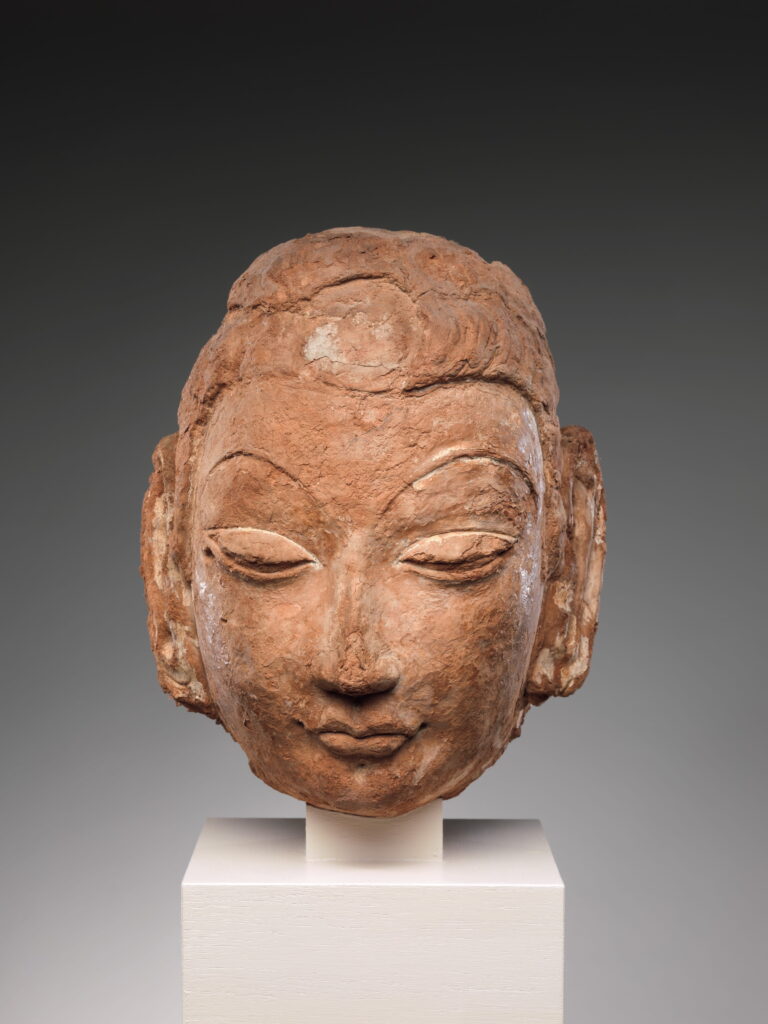
The site was discovered in 1901 by Hungarian-born British archaeologist Sir Mark Aurel Stein. He uncovered the central stupa, the brick platform, and parts of the south-eastern and western stretches of the inner enclosure, as well as the remains of the outer enclosure. During the excavations, he found 91 wall sculptures; some were lost following exposure due to their fragility, while portions of others, such as heads and decorative elements, were removed and taken to the British Museum, where they remain today. Before leaving, Stein covered the sculptures again with sand to protect them. However, when he returned to Rawak in 1906, he discovered that many, if not all, of these sculptures had been looted. In 1928, German explorer Emil Trinkler carried out a new excavation campaign at the site, bringing to light part of the north-western stretch of the inner enclosure along with 39 additional wall sculptures. He also removed sculptural material, now kept in the Übersee Museum in Bremen; some pieces were later acquired by the Metropolitan Museum of Art. The following year, Chinese archaeologist Huang Wenbi made a brief visit to the site. In 2001, Rawak was designated a Major Historical and Cultural Site protected by national law.